


Yayoi Kusama
Download Pdf

The bursting of a bubble is a dramatic and fascinating event. With profound repercussions. It is nothing new. However, the tendency to forget it or, for younger people, not to analyse what happened in the past, is strong.
1) The first consequence of a stock market bubble bursting is a drastic reduction in the investor’s appetite for risk. This applies indiscriminately to all asset classes, even those not affected by the bubble and, in the initial part, even to those that will gain from the burst. It is therefore important to be cool and calm, trying to anticipate the return to normality by buying securities that have been unfairly penalised.
2)The second consequence of the bursting of the bubble is the enormous loss of wealth it causes. This is evidently followed by a marked reduction in the propensity to consume and invest. It therefore acts as a severe restrictive manoeuvre. The bursting of the bubble we are witnessing will put a nice cap on market rates (and the strength of the dollar), which is extremely positive in a context of inflationary hysteria. It could also bring the US into, or very close to, a technical recession. However, a sound financial system and the high level of household savings will prevent chain reactions and the economic recovery will then be relatively quick.

Yayoi Kusama, Infinity Mirrored Room – The Souls of Millions of Light Years Away, 2013. Wood, metal, glass mirrors, plastic, acrylic panel, rubber, LED lighting system, acrylic balls, and water, 287.7 × 415.3 × 415.3 cm. Courtesy of David Zwirner
3) The third consequence is that bubble assets may be untouchable for a long time. In this context, one can observe different behaviour related to different types of investors. a) Fanatical growth investors. These are driven by the same fervours that drove the crusaders in the Middle Ages. They are loyal to bubble themes. Reading Cathie Wood’s biography can help one understand these people. There are no valuation considerations, because what they buy does not, for them, have a fair price. They are the ones who ride the bubble to the most imaginative peaks and accompany it back to hard reality.
b) Opportunistic growth investors. These present themselves as growth investors but actually follow momentum, flair and common sense. They are smart, quick to get out and also quick to get back in. They sell to clients, colleagues, friends, family and even themselves, the amazing qualities of stocks and the endless future opportunities they hold, but in reality, they remain aloof and ready to dump them when needed. After ten years of continuous stock market growth and three years of an imaginative bubble, however, they tend to be bolder and less fast. Every time they have gone out, they have come back higher. This leads them to lose enough before adjusting to the new reality.

Yayoi Kusama, Infinity Mirror Room – Phalli’s Field (Floor Show), 1965/2016 (detail).
Installation view, Yayoi Kusama : Infinity Mirrors, Hirshhorn Museum and Sculpture Garden
c)Opportunistic value investors. These have stayed away from bubble stocks for much of the time. This has created a certain liver ache for them. People with no art and no part produced considerable returns, much higher than theirs, just by following the herd or passively placing themselves on indices dripping with growth. For years they also had to listen to the speeches about the great opportunities this new theme will bring. Impervious as they may be, some of this narrative has permeated into them as well. Once the theme disintegrates and seemingly reaches more comprehensible valuations, this investor first rejoices at the loss of the injustice suffered, but then invests. And he is normally wrong. In fact, the apparently attractive valuations he sees are completely fictitious. A bubble undermines the very functioning of the market. Much of the growth in turnover is the work of the bubble itself. It is precisely this exceptional growth that leads to a continuous rerating of securities, which, by attracting more money and investment, produces further false growth and rerating. It is a house of cards where it is difficult to tell how much is fake and how much is real. This process of self-magnification is reminiscent of the work of Yayoi Kusama and her beautiful mirror constructions (above). A few elements and many mirrors create realities as infinite as they are illusory.
In addition to the above, there is, as has been said many times, regulation. We well remember how the first warnings about antitrust and regulation of the digital sector in 2017/2018 led to fears and takeaways. The current news on this front is truly alarming, but the market seems anaesthetised. Fat and indolent, accustomed to fideistic gain, it does not listen. It will soon taste the consequences.
Bubble stocks that do not fail historically go into oblivion for a long time. The sequence of bad news that the bursting of a bubble releases is incredibly long. Holding on to them risks jeopardising a fortune or a career. It is better to neglect them for a while and perhaps go and rediscover some sectors that have been the subject of previous bubbles and so far irretrievably neglected, such as telephones, financials, utilities, ADAS, lithium cell manufacturers, IT infrastructure (local and hybrid, as opposed to pure cloud), newspapers, broadcasters, retailers, etc. Not forgetting the even more remote geographical bubbles, such as the Japanese, Korean and Indonesian bubbles of the 1990s, areas that after more than two decades of purgatory now present very nice and healthy investment opportunities. Alternatively, for hard-core growth investors, it is better to wait until the Nasdaq continues to cleanse itself of the stocks that were the subject of the recent bubble and its ecstatic investors, in order to repopulate itself with new companies and new trends, as well as more pragmatic and cynical investors. A process that we believe requires a great deal of patience. In the meantime, there is money to be made for dynamic and capable traders during the powerful rebounds.
The Blue Hole

‘The Blue Hole’ is a famous, yet fascinating, marine depression about 70 km off the coast of Belize. Besides being fascinating and famous, this depression is definitely dangerous, and almost 200 people have died there in the last 15 years. Indeed, strong currents, deceptive reflections, deep caves and treacherous sea creatures present great risks to even the most experienced divers.
The Blue Hole reminds us so much of corporate pension deficits. These endless financial holes have the ability to slowly strangle companies. And that is what has happened over the last ten years. The ‘defined benefit’ system used in the past tends to increase and decrease companies’ pension surplus or deficit depending on the change in related assets and liabilities. However, liabilities, i.e. future pensions to be paid, tend to be particularly sensitive to interest rates, which are used to discount the cash flows going to employees. While much hullabaloo is made to alert investors to these pension risks, little emphasis is given when, thanks to rates, these liabilities improve. In the US, for example, the corporate pension deficit has shrunk by almost 200 billion in the last year and coverage has reached 98%, a level not seen since 2007.
In old Europe, we have British Telecom, the company with the largest pension fund in the UK, which at the beginning of 2021 showed a pension deficit of around £7 billion, which a year later, at the end of March 2022, had fallen to £1 billion. Accustomed to the figures of the new economy on the Nasdaq, where companies that do not make a peak are still worth many tens of billions of dollars, all this seems like little. However, for BT, a company with about 100k employees and ownership of the UK fixed-line telephone network, this £6bn represents about 1/3 of its market cap. For E.ON, 70k employees, the pension fund savings over the past 18 months represent 25% of market cap. For Atos, 111k employees, this difference represents over 35% of market cap. For Volkswagen, 670k employees, 20%. That’s a lot, by golly!
If you then consider this significant reduction in debt, together with retained earnings (or realised losses) and about 10% inflation over the last 18 months (we are talking about companies with real assets), BT compared to January 2021 is down 20% (vs. +20% from list). E. ON is down 30% (vs. +10% list price). ATOS was down more than 80% versus -66% from list. Volkswagen was down almost 40% against a 5% drop from list. And one could go on… In short, adjusted for pension funds, retained earnings and inflation over the past 18 months, many old economy companies have an exceptionally strong value profile and are much closer than they appear to be to the March 2020 hole, albeit with much better prospects than then.
Back Read More

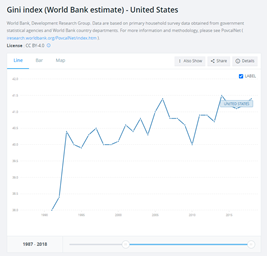
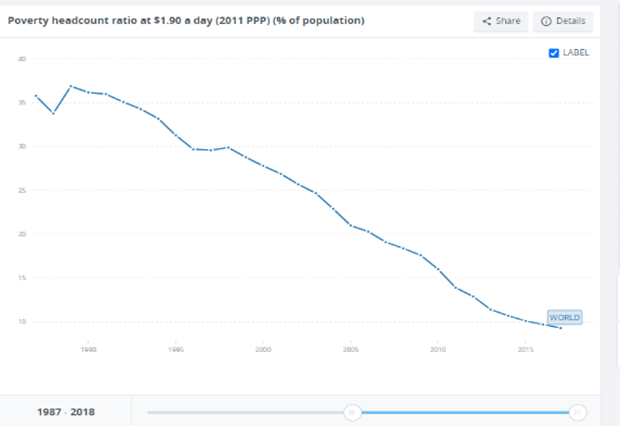 A democracy that does not represent the demands of the majority of citizens, inevitably leads to nationalistic regurgitation. We have seen this recently in the USA, as well as in Europe and elsewhere. Economists such as Stiglitz, Krugman and Korten, who saw risks to democracy in an excessively savage capitalism, have often been sidelined. Today they are being re-read and reappraised.
 autocracy.
 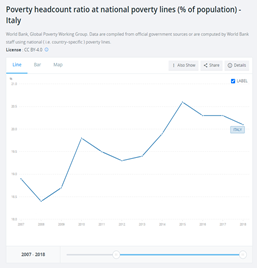 To open a long period of stalemate in the path of progress, like the Middle Ages. However, Covid and the Ukrainian invasion have opened a new phase. A necessary and inevitable phase of deglobalisation. It will bring manufacturing, investment and jobs back to the West. The losers will be the autocracies in the emerging countries, the large Western corporations that sell (and produce) in the emerging countries, and the large and small traders who profit greatly from the fat margins associated with imports from the emerging countries. Europe, like the US, has allocated large funds to help emerging countries, for their economic and democratic development. The opportunities for Western corporations will have to go hand in hand with the democratic development of the countries where they invest.
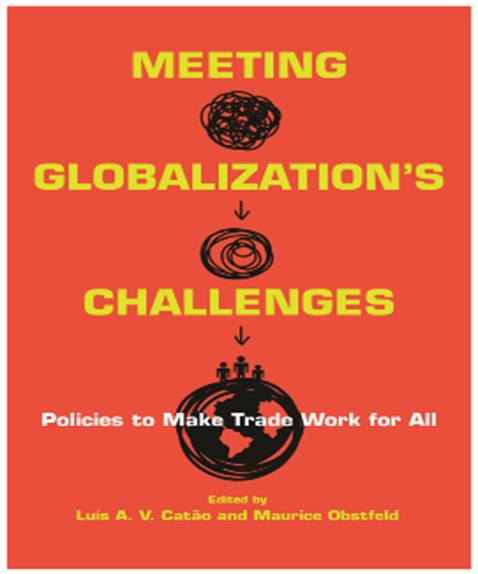 It is precisely her introduction that is a sweetened re-presentation of the narrative offered in the 1990s and early 2000s about the goodness of globalisation. There are several references to papers of dubious quality and transparency showing that globalisation does not lead to job losses in the West. More transparent, however, but highly questionable, is the description of how re-training and social safety nets would protect the weakest in the West from globalisation. While admitting several errors, Lagarde, inevitably, still in 2019 defended the IMF position, written by the US years under the dictation of big corporations, the primary beneficiaries of globalisation. We know that propaganda does not only exist in Russia.
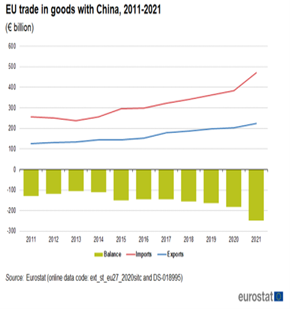 In fact, globalisation soon turned into what some economists dubbed ‘hyperglobalisation‘, responsible between 1998 and 2005 for the loss of 10% of the manufacturing workforce in the West, over 10 million people. This number has continued to rise until today, with damage to the social fabric of the West and its supply chain.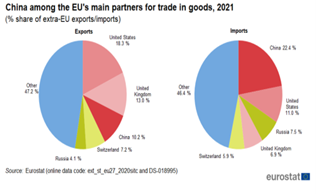


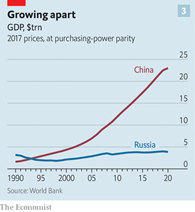 Putin will save face. He will probably sell the war damage to be paid as aid for the friendly country devastated by Nato pressure. However, gradually the truth will come out. In the meantime the Russian population will be dramatically affected, even though many of the sanctions will be lifted in the coming months. This could lead within a couple of years to Putin’s departure, not unlike the departure in 1999 of Boris Yeltsin. A departure apparently voluntary, but in reality obligatory. This should mark the beginning of recovery for this huge country and its unfortunate population, which has not benefited from global growth for the past 25 years. The graph opposite shows the GDP growth of China and Russia over this period.
 Dad told me that the shares Grandpa gave me are no good. He says Grandpa is old and doesn’t understand much about stocks. Dad says that Grandpa’s shares have gone down so much and that I’d better sell them and buy apple. This made me very sad. Also because it seems that what I have left is not enough to buy a PlayStation.
 Atos, an IT consultancy that we have mentioned several times and which is going through a difficult transition phase (it recently came out with yet another profit warning), has a division called BDS. The acronym stands for big data and cybersecurity. This division is considered one of the leaders in cybersecurity and is clearly the first choice of the thousands of customers of Atos’s other divisions. The BDS division has sales of around 1.5bn EUR and has been valued at 3 to 4bn EUR. It recently received an initial bid from Thales of 2.7bn EUR, which was rejected.
