


Diagnostics faces favourable demographic tailwinds, but valuations still suffer from the Covid hangover
Ageing is the most predictable trend in economics. Everybody who will be eighty, eighty-five or ninety in 2050 has already been born. No adoption curve or technological breakthrough is required. At the same time, better access to information and higher incomes mean that consumer tastes and needs are changing: people know more about their own health than any generation before them, earn more, and increasingly want to be tested — when their governments are not already telling them to — in order to catch and treat disease early, or simply to feel, and look, better. They are probably more narcissistic, more anxious and more ambitious: it has been argued that, having largely tamed famine, plague and war, humanity has set itself a new project, i.e. immortality.1
And yet, while these demand drivers are so predictable, the listed companies whose business is to look after those people and those needs — mainly nursing homes, clinics and diagnostic laboratories — sit among the cheapest corners of global equity markets, the United States aside.
The sector has been sold as “grey gold” several times, has bubbled several times, and has never fully delivered. Then came Covid, which created overcapacity in diagnostics and put care homes on the front pages for the worst possible reasons; and then the Orpea affair in France, which erased more than 95% of the value of Europe’s largest operator and tainted everything around it.
This article deals with clinics and diagnostics — an area of the theme far away from European care homes, but still severely affected by the Orpea scandal. Laboratories, testing companies and the manufacturers that supply them were in fact repriced twice: once as the pandemic windfall ran off, and once again by association with the care operators next door. What is left today is a group of businesses with no expensive residents, no sale-and-leaseback obligations and no reputational file, whose volumes are set in large part by public screening programmes, and which in many cases trade under five times EBITDA and/or below the value of their tangible assets.2
Needless to say, we take no satisfaction in a business model that depends on people needing to be tested and treated. Yet diagnostic and clinical work has to be done by somebody, and the companies that do it well deserve capital rather than the neglect they have received over recent years. Our argument is simply that a structural and entirely foreseeable increase in the volume of testing an ageing society requires — and in the machines, reagents and consumables that testing consumes — is not reflected in the price of most of the companies concerned.
This is the second of a series of Niche Insights on the ageing theme. The first dealt with nursing homes and senior living. Forthcoming articles will delve into the companies offering products and services that help people live longer, healthier, more comfortable and more active lives — from pharmaceuticals, nutrition and cosmetics to ageing technologies and leisure. These are all distinct areas that share a common demographic driver but remarkably little else, contributing to portfolio diversification and lower correlations within the theme.
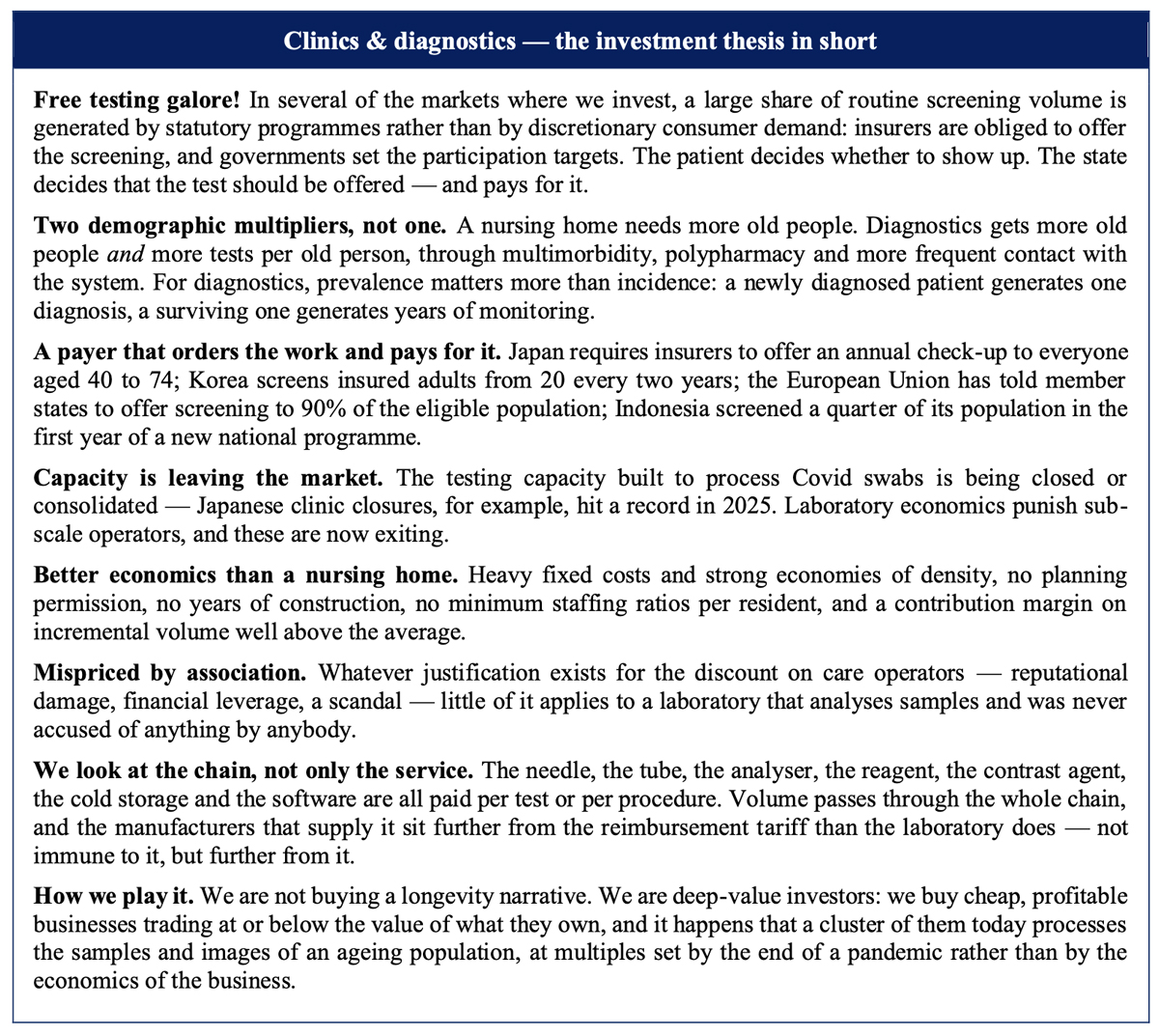
What the pandemic gave, and what it took away
In 2020 and 2021, courtesy of the Covid pandemic, diagnostics had the best two years in its history. Testing volumes that no health system had ever contemplated were ordered, financed and paid for at speed, and the industry responded exactly as it was asked to: it bought analysers, hired staff, opened collection points and built processing capacity.
Capital followed. In 2021 alone, private equity paid 12.9 times EBITDA for France’s Cerba and 13.3 times for Italy’s Lifebrain, and 13.1 times was paid for Unilabs — the largest transaction the European laboratory sector has ever seen — while Synlab, Europe’s biggest listed operator, came to market in Frankfurt.3 Laboratories were, briefly, a growth industry with an infrastructure multiple.
Then the Covid swabs stopped. Revenue fell back towards its pre-pandemic trend, but the fixed cost base did not, and neither did the debt raised against pandemic earnings. Operators diversified into hundreds of additional tests and screens to defend the contribution margin, but in many cases that has not been enough to cover the fixed costs of the sites built for a pandemic. Testing centres closed and groups consolidated. Synlab was taken private again barely three years after its listing, and by the same owner that had floated it.4
Not everybody emerged from that in the same condition. The companies that levered themselves against pandemic earnings are a different proposition from the companies that simply banked them. Yet the market has de-rated the whole sector indiscriminately and is still pricing it as though the industry’s normal condition were the one that prevailed in 2023 rather than the one that will prevail in five years and beyond.
Contagion, without even the partial excuse
After Covid came the Orpea affair. When the market repriced European listed ageing after Les Fossoyeurs, it repriced clinics, laboratories and nursing homes alike.
Yet whatever justification exists for a reputational discount on care homes across very different geographies, none of it applies to a laboratory that analyses samples, that has no residents and that was never accused of anything by anybody. Here the discount is contagion in its purest form, without even the partial excuse that investors can claim about nursing home operators.
Times are changing? What the private market has been paying
Something seems to be changing. The gap between what diagnostic assets fetch in private equity transactions and what they cost on an exchange is telling.
In May 2026 Jardine Matheson agreed to acquire I-MED, the largest radiology business in Australia and New Zealand, from a private equity seller at an enterprise value of $2.4 billion — 11.5 times EBITDA.5 In the same weeks QuidelOrtho, a US diagnostics group whose shares have fallen close to 90% over five years, put its point-of-care testing division up for sale at around ten times its EBITDA, with private equity bidding for it.6
Recent transactions and reported sale processes have therefore valued diagnostic assets at around ten to twelve times EBITDA, while many listed companies in the diagnostics sub-niche trade at under five. Part of that gap could be justified. I-MED, for example, is larger and better capitalised than most of our holdings, and control of an asset is worth paying for. Even that difference, however, is not worth five turns of EBITDA.
A spread that wide will probably give other financial and strategic buyers an incentive to keep taking listed operators private.
We would own nothing solely in the expectation of a bid, and we would not claim these transactions put a floor under the sector, but they are a useful reference point for what strategic and financial buyers have been willing to pay for diagnostic assets… and that reference point is roughly double the listed price.
The chain behind the test
A test looks like a single transaction. Yet it is a sequence of seven or eight transactions, and the company that performs the test is only the last of them.
Somebody manufactures the needle, the tube and the additive inside it. Somebody moves the sample at a controlled temperature and logs that temperature. Somebody builds the analyser and places it in the laboratory. Somebody supplies the reagent, the calibrator and the quality-control material that the analyser consumes on every run. Somebody supplies the refrigerator and the −80°C freezer in which what is left of the sample is stored, sometimes for years, because a regulator requires it. And somebody supplies the software that connects all of it back to the prescriber. The equivalent chain in imaging runs from the scanner and its detectors through contrast agents and image storage to, increasingly, remote reading.
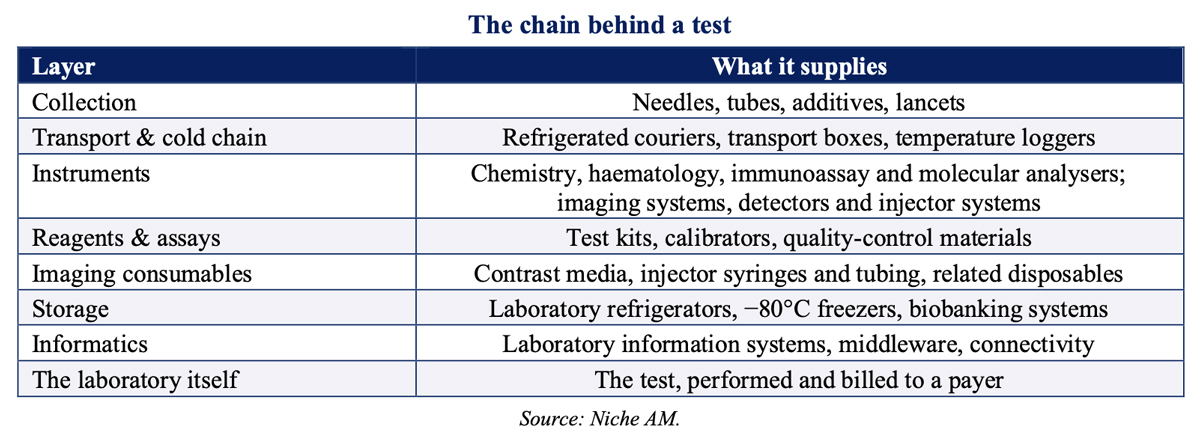
Source: Niche AM.
The post-Covid correction was violent across the whole value chain, but it is upstream that we think the market got it most wrong.
The pandemic pulled forward several years of instrument demand into a very short period; when the orders stopped, capital sales collapsed — in some cases by 80% or more — and the market marked the manufacturers on that collapsed line. But an analyser installed in 2021 does not disappear in 2023. It consumes reagents, controls and service for the rest of the decade, on a menu of tests that has since been widened well beyond the one it was bought for.
The same applies to imaging: a scanner is bought once and depreciated over years; the contrast agent injected into the patient is consumed on every examination, manufactured under pharmaceutical rules by a short list of companies, and billed per procedure. As examination volumes rise faster than the installed base of machines, the consumable layer grows faster than the equipment layer. The same logic runs through the whole chain: the razor is cyclical; the blade is not.
The installed base behaves far more like an annuity than the market gives it credit for. Reagents and kits account for roughly 69% of the value of the global in vitro diagnostics market against about 31% for the instruments themselves. On many major platforms, third-party reagents cannot readily substitute for the manufacturer’s own products. What the buyer is really purchasing is not a machine but years of recurring consumables.7
Consumables are often misrepresented as “commodities” and valued accordingly. This is totally wrong, and one recent case can be used to refute that view.
In 2021 a single manufacturer notified customers of supply problems with blood collection tubes. By January 2022 the US Food and Drug Administration had placed every type of blood specimen collection tube on its device shortage list, and NHS England had instructed medical directors, general practitioners and pathology laboratories to urgently limit non-essential blood testing in order to conserve them.8
A plastic tube costing a few pence rationed diagnostic testing across national health systems for the better part of a year. That is what a genuinely concentrated, genuinely non-substitutable input looks like, and it is a poor description of a commodity.
This pattern repeats across most layers. Laboratory refrigeration and −80°C storage is a global market in which the top five manufacturers hold around 60% of the volume, several of them Japanese and Chinese — their market power and economics are driven by validation, monitoring and energy-efficiency requirements that tighten rather than relax.9
Within the ageing theme, then, we look for investment opportunities across the whole diagnostic chain, i.e. not only laboratories.
A better healthcare business
Relative to nursing homes, barriers to entry are different but no softer. Laboratory economics combine heavy fixed costs — analysers, accreditation, information systems and a sample collection network — with strong economies of density: once the platform and the logistics exist, incremental volume carries a contribution margin well above the average, and a sub-scale entrant cannot match it. Efficiency analyses of primary-level laboratories place the threshold of optimal scale at well over 150,000 automated tests a year — a level a small independent site cannot reach.10
Crucially, none of that requires planning permission, years of building construction, expensive rental agreements and/or high labour intensity. Upstream, in instruments and reagents, the barrier is different again and at least as high: an installed base, a certified product file and a service network.
Switching costs are elevated. Hospitals and insurers do put laboratory contracts out to tender, and they do move them. But established sample flows, accreditation, information-system integration and physician relationships are sticky, and a prescriber who has used the same laboratory for a decade rarely changes it on price alone.
The demand behind clinics & diagnostics is also somewhat less discretionary than for nursing homes. A screening invitation in Japan, Korea or Italy is not something a household decides to buy: it is a recurring, publicly funded, population-wide entitlement that arrives whether or not anybody has felt unwell, with a participation target set by government. Ageing then raises the number of tests per person structurally — more chronic conditions to monitor, more drugs to dose, more frequent contact with the system — and every one of those tests consumes a tube, a reagent and a share of an analyser’s working life. Volume growth does not depend on persuading any grandfather or grandmother to go and live in a nursing home.
Because nursing homes and diagnostics are routinely bundled together — by index providers, by thematic funds and, we would argue, by the market that de-rated them together — we thought it useful to set out where they differ in the table below.
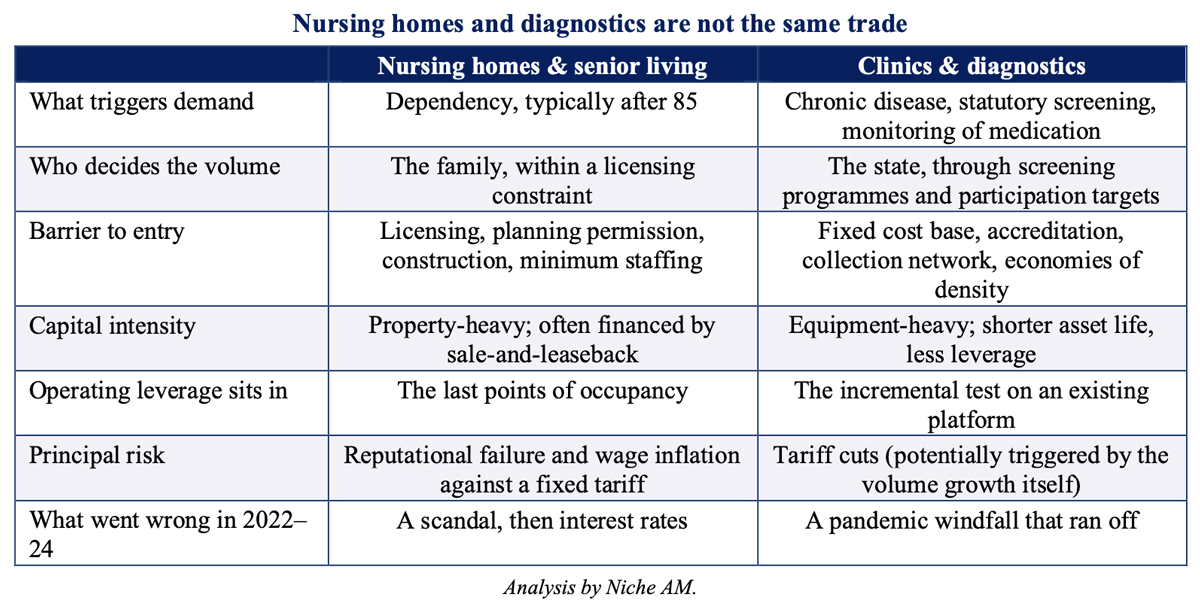
Three sources of demand
1. Ageing raises testing intensity as well as the number of patients
The demographic arithmetic set out in the first article of this series — roughly 830 million people aged 65 or over today, about 1.6 billion by 2050, and an over-80 cohort tripling to around 426 million — matters differently here. A nursing home needs a person to become dependent. A laboratory only needs them to acquire a chronic condition, and chronic conditions arrive decades earlier than frailty. This is a structural difference between the two sub-niches: a nursing home benefits from one demographic multiplier, the number of very old people. Diagnostics benefits from two — the number of old people, and the number of tests per old person.
Put more precisely: for diagnostics, prevalence matters more than incidence. A newly diagnosed diabetic generates one diagnosis. A surviving diabetic generates years of glycated haemoglobin, renal function and lipid monitoring. Longer survival therefore compounds diagnostic volume even if the rate at which people fall ill does not rise at all.
The morbidity gap discussed in our first article — 10.7 years of life spent in poor health today, against 8.8 a generation ago — is a demand curve for testing, and for the equipment and consumables testing requires, as much as it is one for care.11
2. The screening is compulsory, or very close to it
This is the part of the sub-niche that has no equivalent in nursing homes, and it is the reason we treat clinics and diagnostics as a separate investment case rather than a variant of the same one. In the markets where we invest, the volume of tests is not principally a function of illness. It is a function of policy.
In Japan, for example, since 2008 insurers have been legally required to offer an annual check-up — the tokutei kenshin — to every insured person aged 40 to 74, screening for metabolic and cardiovascular risk, with employers under a parallel obligation for their employees. The insurer pays. Participation reached 61.5% in the year to March 2025, up from 53.1% seven years earlier, and remains below the government’s aggregate 70% target: the shortfall is itself a policy dial the state has committed to turning.12
In Korea, the National Health Insurance Service provides a general health examination to insured adults from the age of 20, every two years and annually for non-office workers, alongside a separate national cancer screening programme covering stomach, liver, colorectal, breast, cervical and lung cancer. Around 40% of Korean medical institutions are designated providers, which is to say that the state distributes this volume to private capacity.13
In the EU, member states should ensure that 90% of the eligible population is offered breast, cervical and colorectal screening, and should move stepwise towards organised programmes for lung, prostate and, in high-incidence countries, gastric cancer. Roughly €80 million has been committed under EU4Health and a further €95 million under Horizon Europe.14 The 90% figure is clearly a target for invitations, not an attendance rate, but the direction of travel is what counts.
In Indonesia, in February 2025 the government launched Cek Kesehatan Gratis, a free national health check offered to every citizen around their birthday. It is aimed explicitly at the roughly 70% of the population the health ministry judges unable to afford a check-up otherwise — 200 million people over five years — and it is delivered through some 10,000 state-run community health centres and 20,000 private clinics. In its first year it screened more than 70 million people, around a quarter of the population; the target for 2026 is 136 million.15
Diagnostic capacity will be a clear constraint on programmes of this size, but diagnostic capacity is exactly what we own or aim to own. A programme on this scale is also an equipment order and a capital expenditure programme for the whole diagnostic supply chain: screening 136 million people requires analysers, reagents, imaging systems and cold storage that do not currently exist in the country.
Screening is not a one-test event
This last point deserves separating out, because it is the mechanism that makes government screening programmes worth more to a diagnostics business than their headline volumes suggest. A national screen generates an initial test. An abnormal result then generates a second chain of activity: confirmatory blood work, imaging, pathology, specialist assessment and, if treatment begins, recurring monitoring for as long as the patient is on it.
Diagnostics therefore sits on both sides of government-mandated screening — before it, to find the disease, and after it, to manage it. The economic relevance of a screening programme extends well beyond the single test that appears in the government’s budget line.
None of these public programmes was designed to enrich shareholders, and none of them is certain to reach its targets. Yet they are mandated by existing law, funded within existing budgets, and carry published participation targets. What they establish is that in this sub-niche the government is not merely a payer, as it is in nursing homes: it is the party that generates the demand.
In nursing homes the state pays. In diagnostics, it also orders.
3. A smaller private-pay layer, which we treat as upside rather than thesis
Beneath the statutory volume sits a second, faster-growing but much smaller layer of demand that has nothing to do with either frailty or policy: preventive health checks and self-initiated testing, bought and paid for by the patient. People are wealthier, better informed and more anxious about their health than any previous generation, and a growing share of testing is purchased rather than prescribed.
A large cross-sectional study found that the severity of “cyberchondria” — repeated online health searching that increases rather than relieves distress — independently predicted higher use of family physicians, specialists, hospital admissions and emergency services, after controlling for health anxiety itself and for sociodemographic and health status variables.16
We are not building our investment case on this. Yet it is incremental, self-financed, high-margin volume arriving at a fixed cost base that already exists — i.e. optional upside.17
The supply side: capacity is rationalising
Everything so far has been about growing demand. The other half of the investment case concerns supply, which is also seeing positive drivers.
Capacity built for the Covid pandemic is being removed, and sub-scale providers in several markets are exiting or consolidating. The result is not necessarily scarcity, but more volume flowing through fewer, larger, fixed-cost platforms.
The pressures differ by market, and they point the same way. Where a public payer has cut tariffs hard — France is the clearest case, with cumulative reductions of more than a fifth in under two years — a fragmented base of more than 4,220 private laboratory sites cannot absorb the cut on a fixed cost base, and is likely to shrink markedly.18 Where the constraint is demographic rather than fiscal, the effect is the same by a different route: in Japan, medical institution closures and bankruptcies hit a record in 2025, and more than half of clinic proprietors are over seventy, so a large share of what is closing is retirement without succession rather than failure.19 In both cases capacity leaves from the least efficient end — single-site, owner-operated practices with no ability to spread fixed costs — in markets whose demand for that capacity is guaranteed to rise.
Regulation is closing the door behind the incumbents
The barrier to entry in the supply chain has just been raised, in Europe, by law. Under the old in vitro diagnostics directive, roughly 80% of diagnostic products were self-certified by their manufacturers. Under the In Vitro Diagnostic Regulation that ratio is approximately reversed: around 80% now require notified body certification, most of them for the first time, at a cost that runs from tens to well over a hundred thousand euros per product line. The transition deadlines have been extended three times — to the end of 2027, 2028 and 2029 depending on risk class — for the straightforward reason that there is not enough notified body capacity in Europe to certify the products that exist.20
The intent is patient safety, and we do not question it. The commercial effect is a compliance cost that is close to fixed per product line, levied on an industry in which a great many product lines belong to small manufacturers. They withdraw products, sell themselves, or stop developing new ones. Concentration rises.
For the time being, labour remains a constraint (but AI is looming)
As in nursing homes, another capacity constraint is people — at least for the time being and before AI is potentially used to replace labour. Vacancy rates in clinical laboratories have come down from their 2020–2022 peak but remain above pre-pandemic levels across the developed world, and the pipeline of medical laboratory scientists has not expanded to match. Physician workforce projections point the same way: pre-AI US modelling shows a shortfall running into the tens of thousands by 2033 across the specialist grouping that includes radiologists and pathologists, while imaging volumes keep rising.21 A competitor cannot open a laboratory or a reading room it cannot staff (the same barrier to entry we described for care homes).
What the payer will, and will not, give you
It would be easy, and wrong, to conclude from the above that shrinking supply against rising demand produces pricing power. In a regulated sector it does not, or at least not directly.
Where the state sets the tariff, a reduction in capacity improves the utilisation and the margins of the survivors; it does not lift the price. France demonstrated this in the sharpest possible way: volumes rose, and the price fell precisely because volumes rose. The public budget, not the market, sets the revenue. A public payer under fiscal strain has no incentive to index a laboratory’s tariff to its cost bill.
So the return in this market niche does not come from price. It comes from three other places. First, volume, which is growing structurally and which the public payer is actively promoting through participation targets even while capping the price per unit. Second, operating leverage: in a business with heavy fixed costs and strong economies of density, incremental volume arriving at an existing platform carries a contribution margin far above the average, so a flat tariff and a rising sample count is a margin story. Third, consolidation: as sub-scale sites close, their volume does not disappear — it migrates to the surviving networks.
That is arguably a less exciting mechanism than pricing, but it can still prove a reliable one, and it is in many cases available today at four to five times EBITDA.
It is also part of why we look at the manufacturers alongside the service providers: an instrument or consumables maker is paid for the test being run, not for the tariff at which that test is reimbursed.
The logic is straightforward. A laboratory absorbing a cut in what the state pays it still draws the same blood, still runs the same assays, and still buys the same tubes, needles and reagents. Volume — the half of the equation that is growing — passes through the entire chain. Price is set at the final step, where the service is billed to a payer. The further upstream we go, the more the investment case shifts from reimbursement economics towards installed-base and volume economics.
That is an advantage we would not want to oversell. A laboratory whose tariff has been cut negotiates harder with its suppliers, tenders more aggressively and is more willing to move to a cheaper platform at contract renewal. Pressure does travel up the chain; it simply travels slowly and arrives diluted. Over a full tariff cycle the supplier keeps more of the volume growth than the service provider does — not all of it.22
Why now?
We are not in the business of timing entries and exits. In our view, the narrower question which merits our take is what has changed.
What has changed is that the pandemic distortion has largely washed out of the numbers while it has not washed out of the multiple. The comparison base against 2020 and 2021 is now clean: 2025 and 2026 revenues are non-Covid revenues, growing at non-Covid rates. The capacity built for the pandemic has been closing for three years, and screening programmes are being expanded in most markets.
There is perhaps one element of “timing”, which, however, we hold more as an expectation than as a way of outsmarting the market. A great deal of diagnostic equipment was placed in 2020 and 2021, and part of that installed base is now approaching the period in which laboratories typically reassess, upgrade or replace platforms. If that is right, the capital sales line that collapsed after the pandemic could more or less gradually recover from its valuation trough. We treat this as potential upside rather than as the core case.
Clearly, none of this is news to anyone who follows the sector, and yet the sector has still not re-rated.
Risks to the investment thesis
Four developments could erode the case. As with nursing homes, the downside could be limited by owning cheap and profitable companies holding net cash or trading near the value of their tangible assets.
1. The payer squeezes harder. This is the first risk by both probability and impact, and France has already demonstrated the mechanism: volume growth invites tariff cuts rather than higher spending, and a public payer under fiscal strain has every incentive to keep the budget flat. Our defence is not optimism about government finances but being exposed to: operators with the density to absorb price cuts that sub-scale competitors cannot; parts of the chain a step away from the tariff; and companies trading near or below tangible book.
2. AI. Two recent studies published in Nature reported specialist medical AI systems matching or beating physicians in controlled simulations.23 Yet a machine that reasons better than a doctor about what medical condition to diagnose is still a machine that generates further samples and tests; it does not draw blood, manufacture a reagent or run an analyser by itself. Physicians (labour) could be at risk, but not the diagnostics industry and its shareholders. On the other hand, if artificial intelligence lets a radiologist read more studies an hour, the effective capacity of an imaging centre rises without a new scanner being bought — which is good for the imaging centre but arguably not as good for the scanner suppliers.
3. Testing leaves the central laboratory. Point-of-care devices, self-collection kits and home testing move volume away from the centralised platform on which laboratory economics rest. This is a genuine structural risk to laboratory networks specifically, and it is one reason why we also look at the makers of the instruments and reagents that decentralised testing still needs to consume. Complex, high-acuity and confirmatory testing remains centralised for reasons of accreditation and cost.
4. Consolidation does not happen. Our margin argument assumes that the volume released by closing sites migrates to scaled operators. In some markets that migration could be slower and less complete than we assume.
And one risk to the upside, which we would rather see not materialise. Nobody wants another pandemic, and we are not forecasting one. But the possibility is real, and in that event this niche would be one of the parts of the equity market that would hold up better.
Investment conclusion
A substantial part of diagnostic growth across the world is secular and driven by demographics, law, reimbursement policy and participation targets, rather than by the notoriously fickle business cycle. Ageing raises testing intensity per patient as well as the number of patients. Capacity is being rationalised, so more of the growing volume flows through fewer fixed-cost platforms. And many of the companies positioned to process that volume — together with the chain that supplies them — trade under five times EBITDA and/or below the value of their tangible assets.
The market de-rated this business for the disappearance of Covid testing. It has not yet repriced the installed base, the structural screening volume or the consolidation that Covid left behind.
Sources and notes
1 See for example Yuval Noah Harari, Homo Deus: A Brief History of Tomorrow (2015).
2 Niche AM and LSEG.
3 IMAP, Deep Dive into M&A Activity in the European Healthcare Services Industry (2023).
4 Bloomberg, 13 March 2023, and Debtwire / ION Analytics, February 2024.
5 Jardine Matheson Holdings’ agreement to acquire I-MED Radiology Network from Permira, announced 25 May 2026 at an enterprise value of USD 2.4 billion, equal to 11.5 times forecast EBITDA for the twelve months to June 2026, excluding its minority stake in Harrison AI. I-MED operates 215 imaging centres, performs over seven million patient procedures a year and compounded revenue and EBITDA at 11% and 12% respectively over the preceding five years (Nikkei Asia, 25 May 2026).
6 Oliver Barnes and Antoine Gara, “QuidelOrtho looks to sell testing unit as PE circles healthcare companies”, Financial Times, 27 June 2026. The sale process is reported as targeting approximately USD 1.5 billion against roughly USD 150 million of divisional EBITDA, at a group market capitalisation of about USD 940 million and net debt of USD 2.6 billion arising from the 2021 acquisition of Ortho Clinical Diagnostics.
7 Segment split between reagents and kits and instruments as reported by Grand View Research and MarketsandMarkets for 2024-2025. On closed-system structure, five- to seven-year assay contracts and the concentration of roughly half the global in vitro diagnostics market in four manufacturers, Bernstein Research, deep dive on the global in vitro diagnostics market (2023).
8 US Food and Drug Administration, medical device shortage list, 19 January 2022; NHS England, November 2021.
9 GMInsights, Ultra-low Temperature Freezers Market (2026).
10 “Defining the Optimal Size of Medical Laboratories at the Primary Level of Health Care with Data Envelopment Analysis”, Acta Clinica Croatica (2019), and Rezaee et al., “Activity-based cost analysis of laboratory tests in clinical chemistry”, Clinical Biochemistry (2021).
11 “Global, regional, and national trends in the morbidity gap”, The Lancet Public Health, 21 July 2026; analysis by the Institute for Health Metrics and Evaluation.
12 Japan’s Ministry of Health, Labour and Welfare, Specific Health Checkups and Specific Health Guidance.
13 Korea’s National Health Insurance Service; “National General Health Screening Program in Korea: history, current status, and future direction”, Precision and Future Medicine (2022); “Current Status of the National Cancer Screening Program in Korea”, Journal of Preventive Medicine and Public Health (2025).
14 Council Recommendation of 9 December 2022 on strengthening prevention through early detection: a new EU approach on cancer screening, replacing Recommendation 2003/878/EC (OJ C 473, 13.12.2022); European Commission, Europe’s Beating Cancer Plan, flagship initiatives.
15 Indonesian Ministry of Health, Cek Kesehatan Gratis programme, launched 10 February 2025; ministry statement of 10 February 2026 reporting 70 million participants in 2025 through 10,225 community health centres, and the 2026 target of 136 million; GovInsider, April 2026; Nikkei Asia, 15 January 2025.
16 Jankowski et al., “Cyberchondria severity and utilization of health services in Polish society”, BMC Public Health 24 (2024). See also Tyrer et al., “Increase in the prevalence of health anxiety in medical clinics: possible cyberchondria”, International Journal of Social Psychiatry 65 (2019), which found the prevalence of health anxiety in UK medical outpatient clinics rising from 14.9% to 19.9% over four years; and, on the commercialisation of private-pay diagnostics, Kathleen Baird-Murray, “The London members’ clubs joining the wellness revolution”, Financial Times, 28 July 2026.
17 There is also a legitimate public health objection that much of this testing is unnecessary, generates false positives and consumes capacity that should be directed elsewhere. See H. G. Welch and W. C. Black, “Overdiagnosis in Cancer”, Journal of the National Cancer Institute 102 (2010); see also the UK National Screening Committee’s criteria for appraising the viability, effectiveness and appropriateness of a screening programme.
18 Protocole d’accord triennal sur la biologie médicale 2024-2026, signed between UNCAM and the representative unions of laboratory directors in July 2023; Caisse nationale de l’assurance maladie decision published in the Journal Officiel of 3 September 2024; French National Assembly written questions nos. 588, 993 and 2893 (2024); Xerfi, Le marché des laboratoires de biologie médicale (2025).
19 Teikoku Databank; Tokyo Shoko Research (May 2026), reported by The Japan Times, 4 May 2026; Japan’s Ministry of Health, Labour and Welfare.
20 Regulation (EU) 2017/746 on in vitro diagnostic medical devices, as amended by Regulations (EU) 2022/112 and (EU) 2024/1860; MedTech Europe surveys of IVDR readiness and product discontinuation, 2022-2025.
21 American Society for Clinical Pathology, 2024 Vacancy Survey of Medical Laboratories in the United States, American Journal of Clinical Pathology (2025).
22 Protocole d’accord triennal sur la biologie médicale 2024-2026.
23 Michael Peel, “AI medical tools match or surpass doctors for advice”, Financial Times, 17 June 2026, reporting two studies published in Nature: Mira, developed at TUD Dresden University of Technology and Heidelberg University, and Google’s Amie, with comments from Catherine Pope (Oxford), Julie Jacko (Edinburgh) and Wei Xing (Sheffield). See also Deena Mousa, “AI isn’t replacing radiologists”, Works in Progress (September 2025), and “AI solutions to the radiology workforce shortage”, npj Health Systems (2025).
Legal disclaimer
This document, together with any presentation and related material, is intended exclusively for marketing and information purposes. It is not a legally binding document, contains no representation and does not constitute an offer or invitation to invest in any of the funds of Niche Asset Management Ltd. (the “Fund”). Furthermore, it does not constitute a solicitation for any such offer or invitation, nor may it be regarded as part of it or of its distribution in connection with any contract relating to the Fund. This document, any presentation made in conjunction with this document and any related material are preliminary and for information purposes only. They do not constitute an offering memorandum, contain no representation and neither constitute nor form part of an offer or invitation to subscribe for any of the Niche funds (each, the “Fund”). Furthermore, they neither constitute nor form part of any solicitation of such offer or invitation, nor do they (or any part of them), nor the fact of their distribution, form the basis of, or may be relied upon in connection with, any contract relating thereto. The information contained in this document has been compiled solely by Niche Asset Management Ltd (known as “Niche AM”), authorised and regulated by the Financial Conduct Authority (RN783048) and registered in England and Wales 10805355. The information and opinions contained in this document are not intended to be complete and may be subject to change at any time. No representation, warranty or undertaking, express or implied, is given as to the accuracy of the information or opinions contained in this document, and Niche Asset Management Ltd and/or its partners accept no liability for the accuracy and completeness of the information. Investments in the funds are subject to market risks, including the potential loss of capital.
The Fund’s investment strategy is speculative and entails a significant risk of losing part or all of the capital invested. Market, political, counterparty, liquidity and other risk factors may have a significant impact on the Fund’s investment objectives, while past performance is neither a guide to nor indicative of future results. The distribution of this document and the offering of the Fund’s units may be restricted by law in certain jurisdictions, and accordingly anyone coming into possession of this document should be aware of and comply with any applicable laws or regulations. Niche AM’s funds are not yet available for distribution in all countries. Prospective investors are invited to contact Niche AM to verify the countries of registration. Any failure to comply with these restrictions may constitute a violation of the laws of such jurisdiction. The reproduction of this information, in whole or in part, without the prior consent of Niche AM is also prohibited. This document may be communicated or passed only to persons to whom Niche AM is permitted to communicate financial promotions pursuant to an exemption provided under Chapter 4.12 of the Conduct of Business Sourcebook (“COBS”) (“Permitted Recipients”). Furthermore, no unauthorised person may communicate this document or otherwise promote the Funds or the units therein to a person in the United Kingdom, unless that person is (a) a Permitted Recipient or (b) a person to whom an authorised person is permitted to communicate financial promotions relating to the Fund or to promote the Fund under the COBS 4.12 rules applicable to that authorised person. The securities mentioned in this document have not been registered under the Securities Act of 1933 (the “1933 Act”) or under the securities laws of any other US jurisdiction.
Such securities may not be sold or transferred to US persons unless such sale or transfer is registered under the 1933 Act or exempt from such registration. This document is a marketing communication intended exclusively for professional investors. Prospective investors are advised to read carefully the Prospectuses and the Key Investor Information Documents (KIID) for all details, including risk factors and fees, before making any final investment decision.
Prospectuses, supplements, KIIDs and a Summary of Investor Rights are available free of charge at https://nichejungle.com/regulatorydocuments and at https://nicheam.com/legal.
Do you enjoy our Niche Insights? Read more here
Follow us on LinkedIn
Niche Asset Management Limited
Authorised and regulated by the Financial Conduct Authority
17 Lennox Garden, London SW1X 0DB — Registered in England — No. 10805355

