


Great opportunities don’t come cheap
And when they do arrive in the stock market, you are very often exhausted, overwhelmed by fear, and with greed long tucked under the bed.
The aim of NicheJungle projects is to give investors exposure to unique deep-value areas where gaining such access would otherwise be impossible. NicheJungle launches products based on very attractive risk/reward profiles. At launch, these areas are neglected and stagnating, with no interest whatsoever from investors. NicheJungle does not attempt to time the recovery; that is up to the investors who choose which project to invest in. We provide all the necessary information at launch and keep investors continuously informed.
Indonesian infrastructure small caps is one of these projects. We launched it 3 years ago when the market was profoundly undervalued. After 3 years, the project’s performance remains in negative territory, although significantly less so than the MSCI Indonesia Small Cap Index (and there are no active products in this specific niche). Below is an overdue update following recent events.
Indonesia’s main index dropped over 11% in a single trading session on Friday 16th October, its worst session since January 1998, at the height of the Asian financial crisis. This brings its year-to-date loss to over 40% and its 10-year return into negative territory despite the economy doubling in GDP terms over the same period. If we analyse the Indonesian small caps, the return is negative even over a 20-year horizon. For reference, Indian small caps have nearly quadrupled over that time. And, just as a reminder of how emerging markets behave, most of that increase occurred within a 5-year window, from 2020 to 2025.
Indonesia is a major democratic nation possessing vast natural resources. It boasts strong demographics, grows methodically at 5/6% per year, and maintains low public debt alongside a low budget deficit.
So, what is happening?
In brief
- The new government under President Prabowo made a series of missteps by promoting policies that were poorly received by both investors and a large portion of the population.
- MSCI launched a fierce battle to improve Indonesian market governance by reducing the risk of stocks being manipulated to artificially enter the index, which forces passive managers to hold them in their portfolios. There have been 5 such cases in recent years (DSSA IJ, BREN IJ, CUAN IJ, AMMN IJ, TPIA IJ). This battle began months ago and has been relentless. On every chapter of this battle, the market has collapsed. First, MSCI expressed concern on concentration and trading anomalies on some stocks, threatening to demote the country to Frontier Market (end 2025). Then, it froze the weight of Indonesian equities in the index (January 2026). Next, it drastically cut Indonesia’s weight in its Global and Emerging Market indices (May 2026). On Friday 16th, in the latest chapter, it initiated a procedure to move the country not to Frontier Markets, but to “Standalone” status alongside countries like Russia, Ukraine, Lebanon, Nigeria, Zimbabwe, Palestine, and Argentina.
Regarding the first point, Prabowo recently revised some of his policies and appointed respected technocrats to the Ministry of Finance and the head of the Central Bank. Although some interventionist and authoritarian attitudes persist, Prabowo has shown himself to be pragmatic and capable of listening to the public and investors.
Regarding the second point, stock exchange authorities, pushed and supported by the government, immediately got to work to satisfy MSCI’s demands. In particular, these demands focus on:
- Making shareholder registers transparent to verify the actual free float used to calculate index weight;
- Identifying and prosecuting all price-distorting market behaviour; and
- Increasing the minimum required free float to remain listed.
However, as of Thursday, no concrete actions had been taken against those who engaged in these fraudulent practices. Furthermore, while timelines to increase the minimum free float (from 7.5% to 15%) were issued in line with MSCI’s requests, there was a sense that an extension might be granted for the first deadline falling on March 31, 2027. MSCI perceived this as a falsely compliant attitude and brought out its bazooka: threatening the most drastic action available.
In an intentional response on Friday, the Indonesian stock market authority imposed severe penalties (over USD 117 million) on 3 entities found guilty of market manipulation. Alongside this, the deadlines for increasing the free float were confirmed. Unsurprisingly, the first deadline (March 31, 2027) falls exactly one month before the end of MSCI’s consultation period, providing MSCI with enough time to see what action will be taken against non-compliant companies.
In fact, MSCI’s proposal is currently an open consultation running until April 30, 2027 (with a final decision expected by June 2027). Indonesia therefore has a concrete timeframe to implement the required reforms and avoid a permanent downgrade.
MSCI’s stance is unexpected and highly aggressive, something never before seen toward a major country like Indonesia with a market cap well exceeding half a trillion dollars. We believe the reason lies in the extreme importance passive money has acquired today, alongside high-profile cases that occurred in Indonesia over recent years under the passive watch of local authorities. MSCI’s decision is an extreme measure intended to yield concrete results and restore credibility to its procedures.
It is in the interest of both parties, MSCI and Indonesia, to resolve the situation while preserving the status quo. It is worth noting that FTSE, the other major index provider, recently confirmed Indonesia’s position within Emerging Markets following the regulatory measures taken by Indonesian authorities.
What would a move to Standalone status mean in practice?
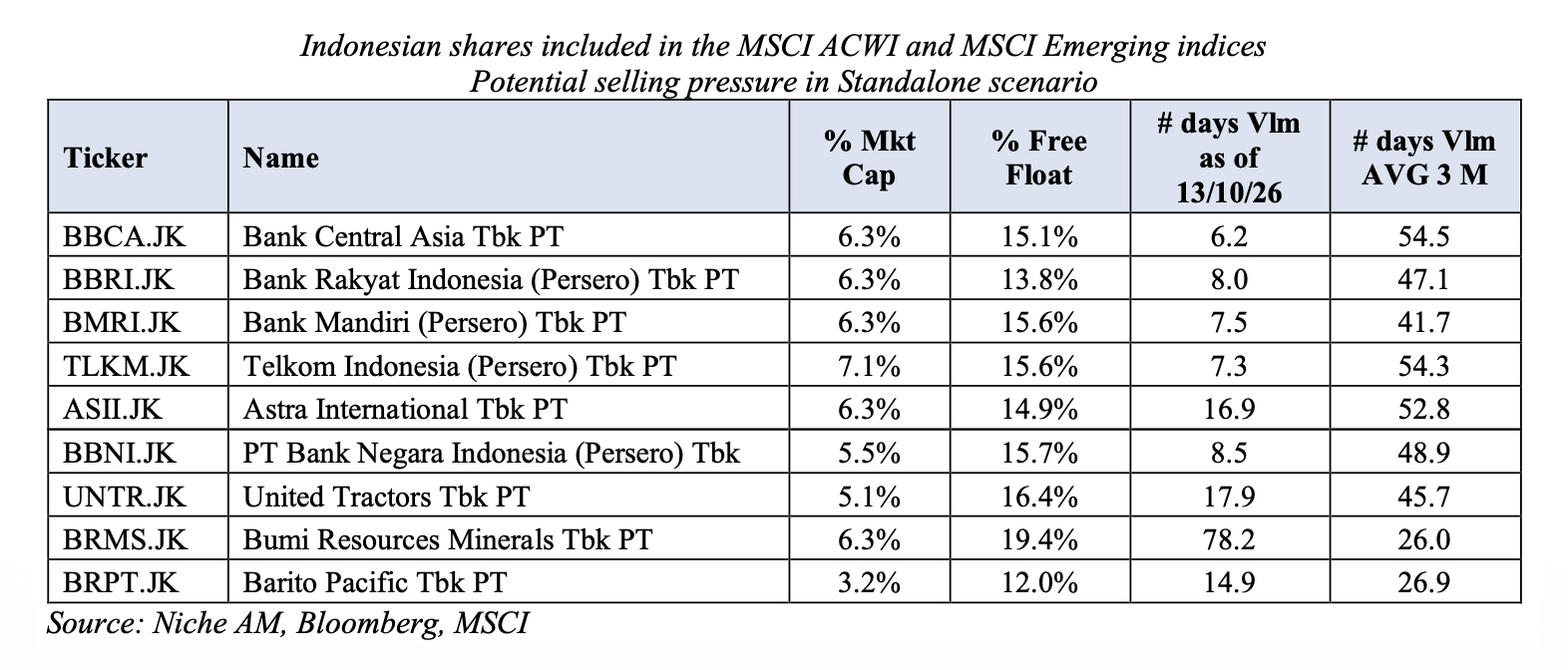
It would mean that the 9 stocks currently forming part of the two main MSCI indices (Global and Emerging Markets) would be removed (BCA, BRI, Mandiri, BNI, Telkom Indonesia, Astra International, United Tractors, Barito Pacific and Bumi Resources Minerals). This would put them under selling pressure. As shown below, a maximum of USD 7 billion could be liquidated on those 9 stocks.

Out of these 9 stocks, we hold none in our NicheJungle Indonesia portfolio.
Technical pressure, real opportunity
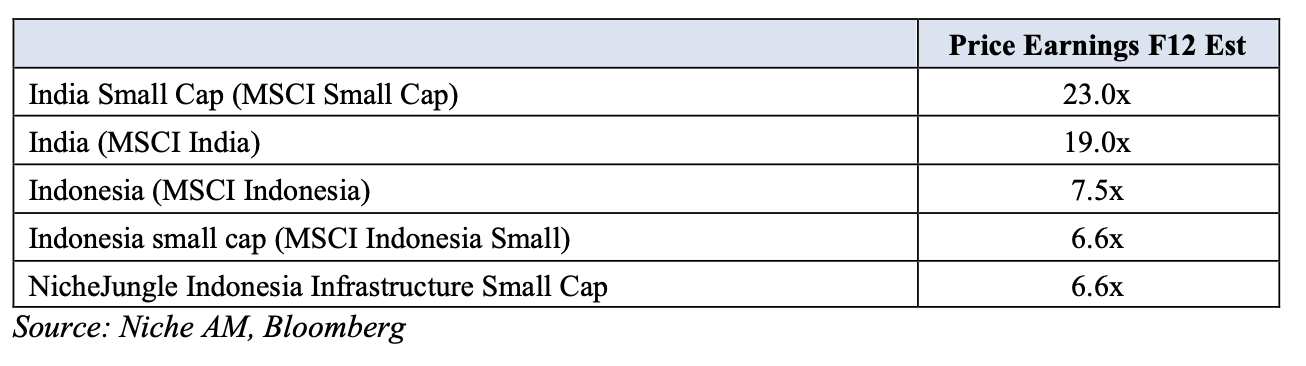
However, these technical pressures can create opportunities for active investors. Indeed, the forced exit of several stocks from the MSCI index in recent months provided us with the opportunity to buy some of them at highly attractive valuations. Below are the valuations (Price/Earnings 2026) of the Indonesian market, compared with India, its closest peer.
PRICE/TANGIBLE BOOK VALUE of the NJ Indonesia portfolio (157 companies) is 0.57x.
The other 956 stocks in the index would experience no pressure whatsoever.
Clearly, being placed in that MSCI category does not look good, but it is important to remember that an entire index is being discarded over a few bad apples amidst a broader, positive backdrop of market governance restructuring. Active managers understand this.
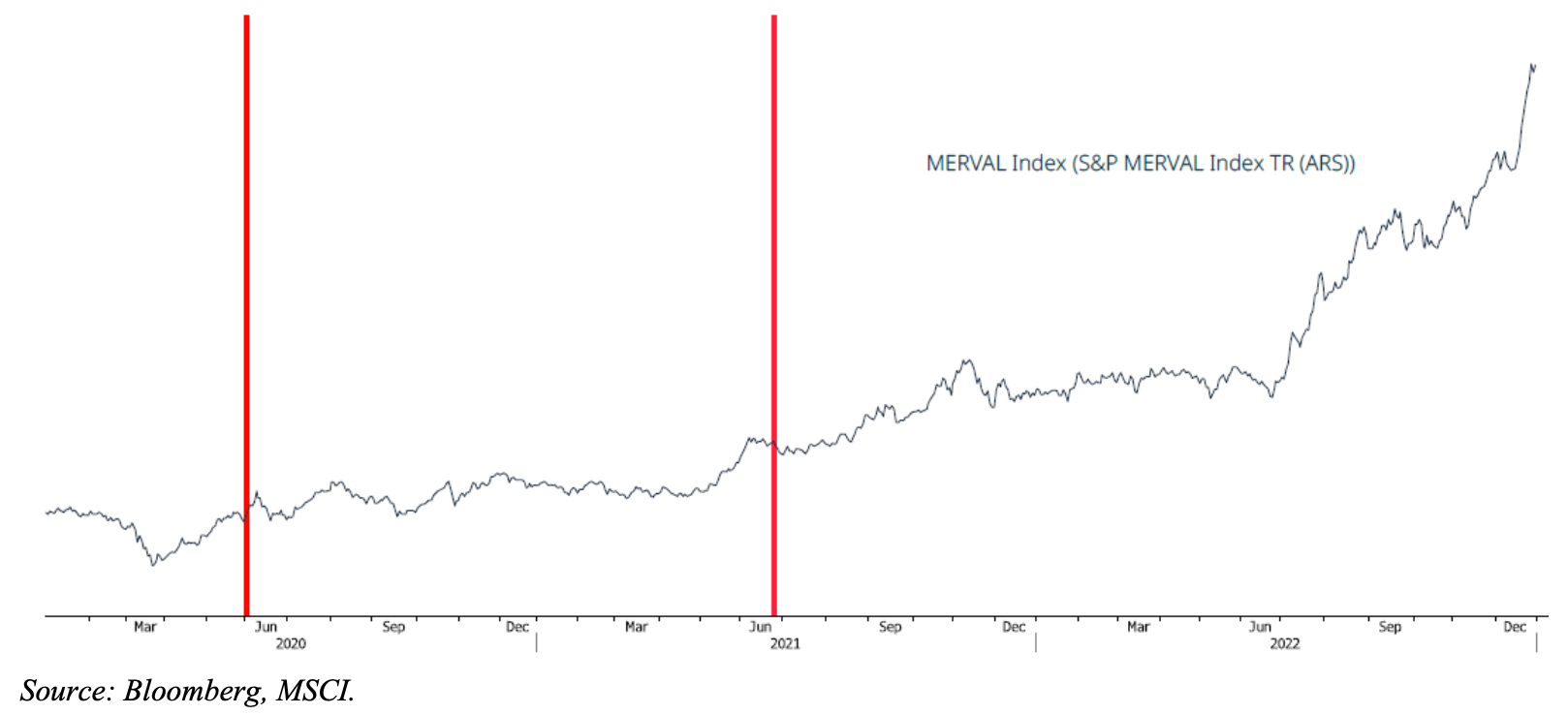
If that were not enough, the chart below shows how Argentina’s Merval Index performed after its reclassification to a standalone market: after some initial pressure following the start of the procedure (first red line), nothing stopped its massive re-rating before and after the official transition to Standalone Market (second red line).
To conclude
- We continue to view a full reclassification of Indonesia as unlikely.
- Regardless of the outcome, we consider this phase extremely important for raising market governance, liquidity, and medium-term attractiveness.
- Regardless of the outcome, this phase offers a unique opportunity to enter or increase exposure to this market at incredible valuations with a fabulous risk/reward profile. Opportunities like this appear once every 20 years, and the time to enter is now.
- Even in the event of an unfavourable outcome, 99% of stocks remain unaffected. Among the remaining 1%, technical opportunities can be seized ahead of their exit.
- Markets hit bottom during extreme phases. Sir John Templeton observed that bull markets are born on pessimism. In South Korea the market bottomed out during the December 2024 martial law/coup attempt. We believe this could be the extreme phase for the Indonesian market.
This is a marketing communication intended exclusively for institutional investors. Please refer to the fund prospectus and KIDs before making any investment decision.
Do you enjoy our Niche Insights? Read more here
Follow us on LinkedIn
Niche Asset Management Limited
Authorised and regulated by the Financial Conduct Authority
17 Lennox Garden London SW1X 0DB – Registered in England – No. 10805355

