


The ugly duckling of Asia
The case for staying in Indonesia when everyone else is heading for the exit
The time of maximum pessimism is the best time to buy, and we believe that for Indonesia that time is now. We may well be the last bulls on Indonesia but we are comfortable with that: it’s always a lonely place just before a possible re-rating.
While the performance in euro terms of our NicheJungle Indonesian Infrastructure Small Caps fund, characterized by a deep value approach, would indicate more boredom than tragedy (as it is almost unchanged since its launch in November 2023), the performance of MSCI Indonesia, also in euros over the same period, delivers an alarming picture: -42%!
The macro backdrop: risks may be plenty, but already in the price
Indonesia offers a compelling long-term growth profile underpinned by demographic strength, a young and expanding consumer base, infrastructure development and abundant natural resources. On key social and financial metrics — per capita wealth trends, household balance sheet soundness, and social equity indicators — Indonesia compares very favourably to regional peers, including India, against which it continues to trade at a ludicrous discount that we consider deeply unjustified.
The fiscal position has deteriorated under President Prabowo. The 2025 deficit reached 2.9% of GDP and is close to the country Constitutional cap of 3%. However, this is below most emerging and developed countries (India 4.3%) and needs to be analysed together with the public debt that stands at a healthy 41% of GDP (India 56%), strong foreign exchange reserves and a solid trade surplus. The rupiah has depreciated approximately 11% against the dollar since Prabowo took office, touching record lows, and Bank Indonesia has been forced to raise rates to defend the currency rather than support growth.
The external environment adds a further layer of complexity. The war in Iran has pushed global oil prices sharply higher, and this matters for a country which is a net importer of crude oil, inflating Indonesia’s fuel subsidy bill. That said, we remind investors that also the coal price has surged and Indonesia exports much more coal in USD terms than imports oil. Hence, the trade surplus won’t be meaningfully affected.
Clearly the Iran conflict has implications beyond Indonesia’s borders that matter for the investment case. With oil prices elevated and inflation risks re-emerging globally, the Federal Reserve’s rate path has shifted materially. Markets that were pricing cuts over the next twelve to twenty-four months are now pricing the opposite — the probability of further hikes has risen, and the recent period of easy dollar liquidity that supports capital flows into emerging markets looks suddenly distant. For Indonesia, this has meant pressure on the rupiah, constrained room for Bank Indonesia to ease, and a higher cost of capital for the sovereign and corporate borrowers alike. These are genuine headwinds. That said, we should remember that wars end, sooner or later, and headwinds can turn into tailwinds.
And here is the critical point: these risks are not hidden. They are on every front page of every media outlet. And have already led to massive capital outflows by foreign investors, taking valuations to unprecedented levels.
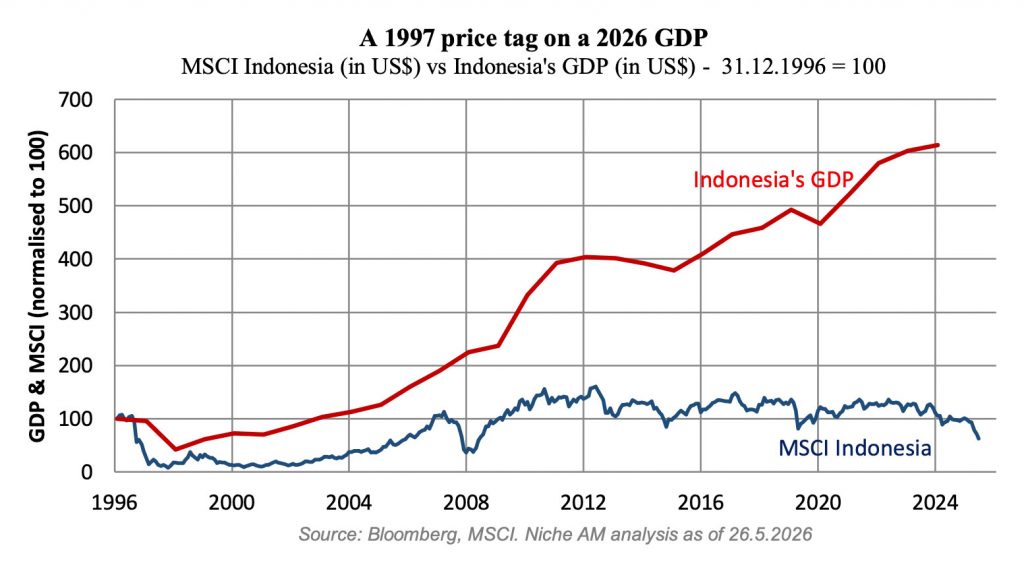
Funnily, the dollar-denominated Indonesian equity index trades today about 40% below both its pre-Asian-crisis 1997 level and its pre-Great Financial Crisis 2008 level — while the economy in dollar terms is respectively 6x times larger and 3x times larger. True, GDP and equity indices measure different things, and one should not expect them to move in perfect lockstep. GDP captures the entire economy — listed and unlisted companies, profits and wages alike — while an equity index reflects only the market’s assessment of the future earnings of listed companies. Yet, the logic is simple: if an economy grows by 6 times, it is very difficult to argue that aggregate corporate profits have remained unchanged. A market trading 40% below where it stood three decades ago is pricing permanent profit impairment – and we find that conclusion very difficult to justify.
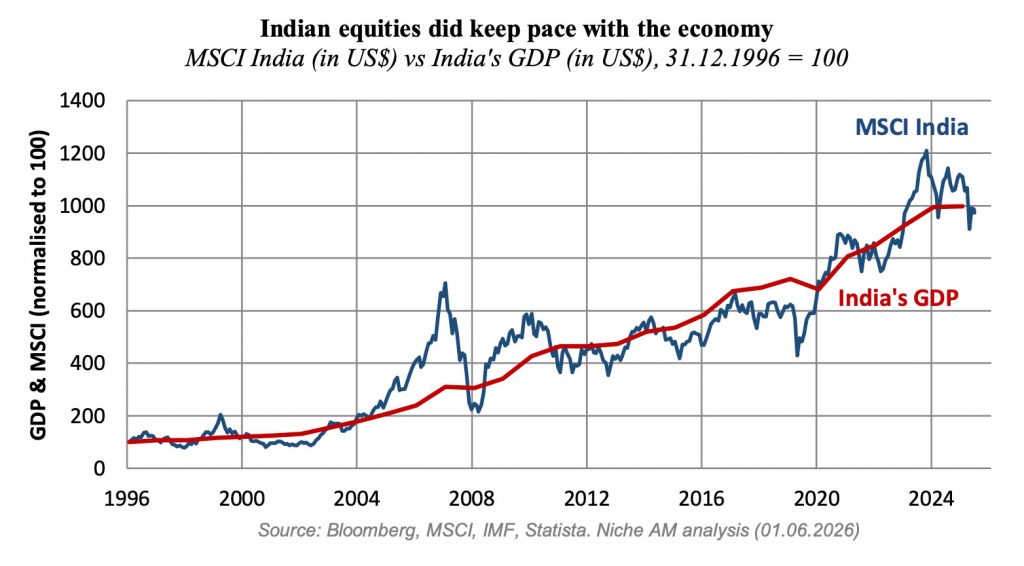
The contrast with India makes the point even more starkly. See the chart below: between 1996 and 2025, India’s nominal GDP grew from approximately $393 billion to nearly $3.9 trillion — a 10x increase. Over the same period, the MSCI India rose by the same amount, i.e. about 10x. In other words, India’s equity market tracked almost perfectly the growth rate of the underlying economy. This is clearly not a story about risk premia across all Emerging Markets. It is a story about sentiment that in Indonesia has become entirely detached from economic reality.
We are aware that markets can, as Keynes reminded us, remain irrational longer than investors can remain solvent, yet at current prices Indonesian assets are discounting something close to catastrophe. The burden of proof against Indonesia lies entirely with the bears.
Prabowo Subianto
Much of the negative narrative around Indonesia centres on concerns about democratic backsliding and economic mismanagement under Prabowo. These concerns deserve a serious response — and a sense of proportion.
Prabowo’s policy instincts are interventionist and statist. His free school meals programme and network of 80,000 village cooperatives is socially and morally laudable but are expensive, and for the market the fiscal arithmetic is uncomfortable. However, as mentioned, the country is financially sound and can well afford it. Furthermore, creating cooperatives that reduce the cost of living for villagers has a medium-term positive impact on inflation.
His political style — building a coalition that now controls 91% of parliamentary seats and his expanded role for the military in public life — raises legitimate questions about the trajectory of Indonesian institutions. However, only a government with strong majority can successfully promote much needed structural reforms.
The Prabowo perceived risk resembles very much the Modi risk in 2014: a leader who perhaps spends too much and centralises too much. That is a meaningful risk in any emerging market, but it is the very medicine that led to the Indian economic and stock market miracle.
Investing in Indonesia is not comparable to investing in an autocratic state with no rule of law, no independent judiciary, no free press, and no mechanism whatsoever for political accountability. And yet many of the same institutional investors who have cheerfully maintained allocations to Saudi Arabia and China — accepting all those risks as a normal part of the emerging market beta — are now retreating from Indonesia on the grounds of governance concerns. This is not rigorous risk analysis. It is momentum bias masqueraded as discipline.
Indonesia holds regular elections. It has a functioning, if imperfect, judiciary. It has a civil society that took to the streets last year in mass protests and was not met with tanks. The central bank is independent and subject to much less government pressure than the FED…
Prabowo refused to declare martial law during last year’s unrest, relying instead on civilian law enforcement. These are not the hallmarks of a regime in the mould of Suharto, let alone Riyadh or Beijing.
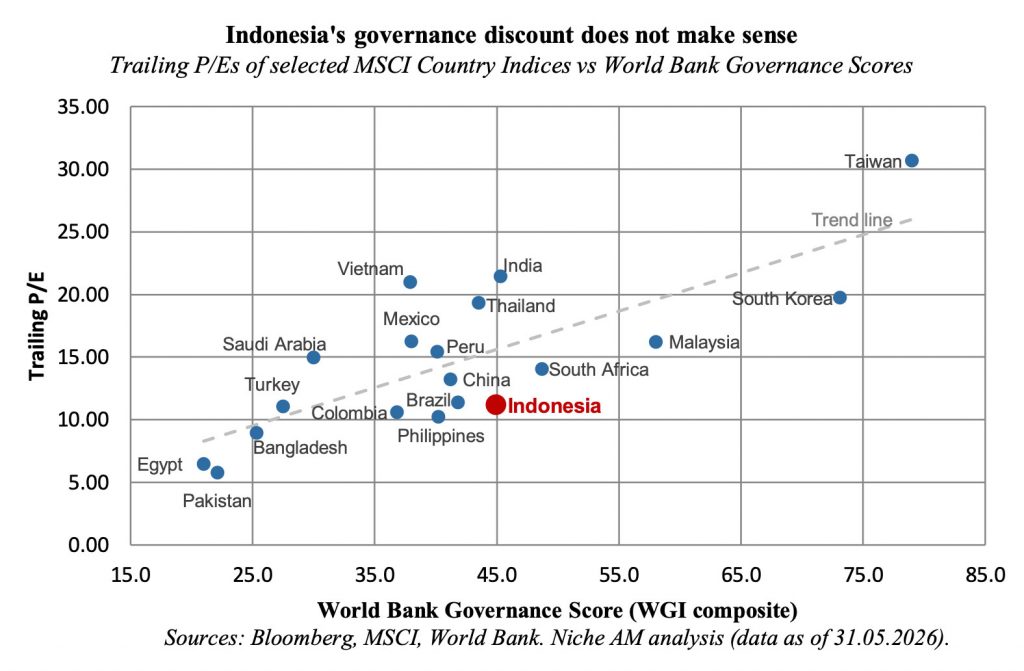
The chart above shows the relationship between a country’s governance standards (as reflected by the World Bank’s scores) and its equity market valuation — better governed markets trade at higher multiples, as one would expect. On this metric, Indonesia scores much better than China, Vietnam and Saudi Arabia or in line with the likes of India and Thailand, and yet, it trades on a large discount vs these markets. In fact, relative to what could arguably be its fair value based on the relationship between governance and valuation, Indonesia is one of the most undervalued markets among EMs — with a gap vs the trendline larger than any other country analysed (except the Philippines).
The export control announcement
A recent development — Prabowo’s May 20th announcement that all exports of palm oil, coal, and ferroalloys must be channelled through a newly created state-owned enterprise — has rattled investors.
The measure is interventionist, and implementation risks are real. The history of Indonesian state-owned enterprises is mixed: some have demonstrated genuine operational capacity; others have become vehicles for patronage and inefficiency. A poorly managed export agency could create bureaucratic bottlenecks, suppress supply, and drive foreign buyers toward competing suppliers.
The deeper policy logic, however, is rational. Prabowo has justified the measure by citing endemic under-invoicing in commodity exports — a practice he estimates cost Indonesia $900 billion between 1991 and 2024. Under-invoicing of commodity exports is not a conspiracy theory: it is a well-documented phenomenon across emerging markets, allowing exporters to understate revenues, minimise tax liabilities, and — critically — retain hard currency offshore rather than repatriating it.
Again, we should remind investors that central dirigisme has been often pivotal to the creation of a strong economy. The Zaibatsu in Japan and the Chaebol in South Korea, for example, have been promoted by dirigiste governments to concentrate investments and develop the economy. Many other countries owe their economic might to centralized economic policies, including in Europe.
MSCI
MSCI’s warning, issued in January 2026, that Indonesia could be reclassified from Emerging Market to Frontier Market status triggered one of the sharpest single-day equity sell-offs in the country’s history.
The concern centred on persistently low free-float levels, potential coordinated trading behaviour, and insufficient transparency around shareholding structures.
This led institutionally constrained funds, whose prospectus rules preclude holding Frontier Market securities, as well as momentum driven investors, to start liquidating part of their positions.
Our view, then and now, is that the MSCI intervention is a welcome catalyst — a necessary escalation to unlock governance reforms that had stalled for too long — and that the probability of an actual downgrade remains low.
The Indonesian regulatory response was unusually swift and concrete: minimum free-float requirements have been doubled to 15% and disclosure requirements for stakes above 5% have been tightened. The incentive to act, given the consequences of a downgrade, was overwhelming.
Unlike the two most recent precedents for MSCI Emerging-to-Frontier downgrades — Argentina in 2009, where the issue was government-imposed capital controls that are structurally very hard to reverse, and Pakistan in 2021, where the market simply lacked sufficient size and liquidity — Indonesia’s problem is one of corporate governance and disclosure.
Concentrated ownership, low free float, opaque shareholding structures. These are fixable problems, addressable through administrative and regulatory action rather than macroeconomic overhaul.
Of course, a downgrade would trigger forced selling from passive vehicles. However, the fundamentals of the underlying businesses would not have changed. Only the index classification would have.
To add insult to injury, MSCI has recently communicated that the weight of Indonesia in the MSCI Emerging Markets Index will be almost halved as from June 2026 to a tiny 0.6% (with instead China + Taiwan + Hong Kong accounting together for more than 50% and India 12%), with this leading to USD1.8bn of outflows.
Valuations: the market is pricing in catastrophe
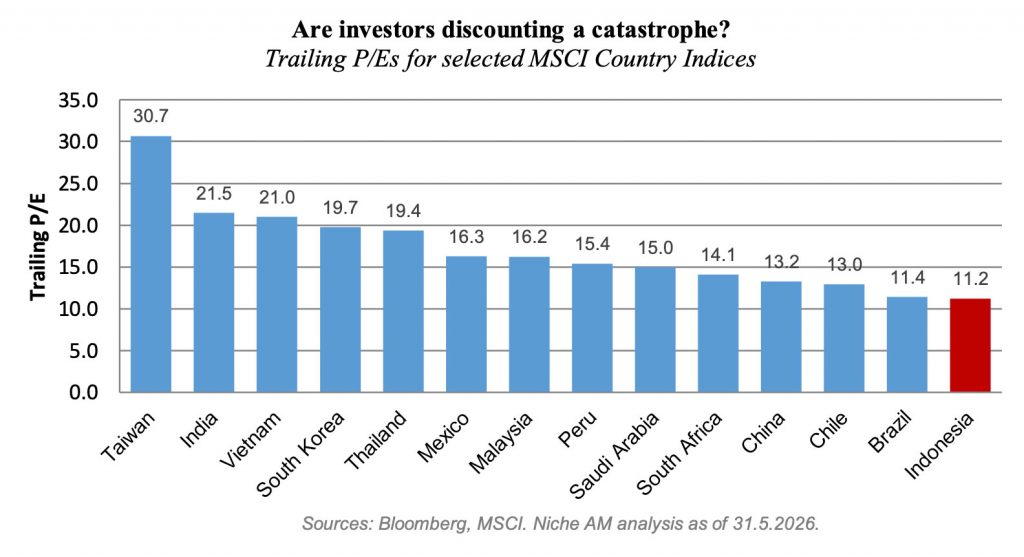
We have already showed Indonesia’s valuation anomaly vs its EM peers. However, those numbers don’t tell the whole truth. In Indonesia, as was the case in India 10 years ago, there is a huge valuation gap between big caps and small-mid caps, the latter trading at much more depressed multiples: here below the valuations of the 20 holdings in our Indonesian portfolios, companies that are extremely solid and with a bright outlook (financial companies do not have EBITDA multiples). The whole portfolio trades at a P/E below 7x.
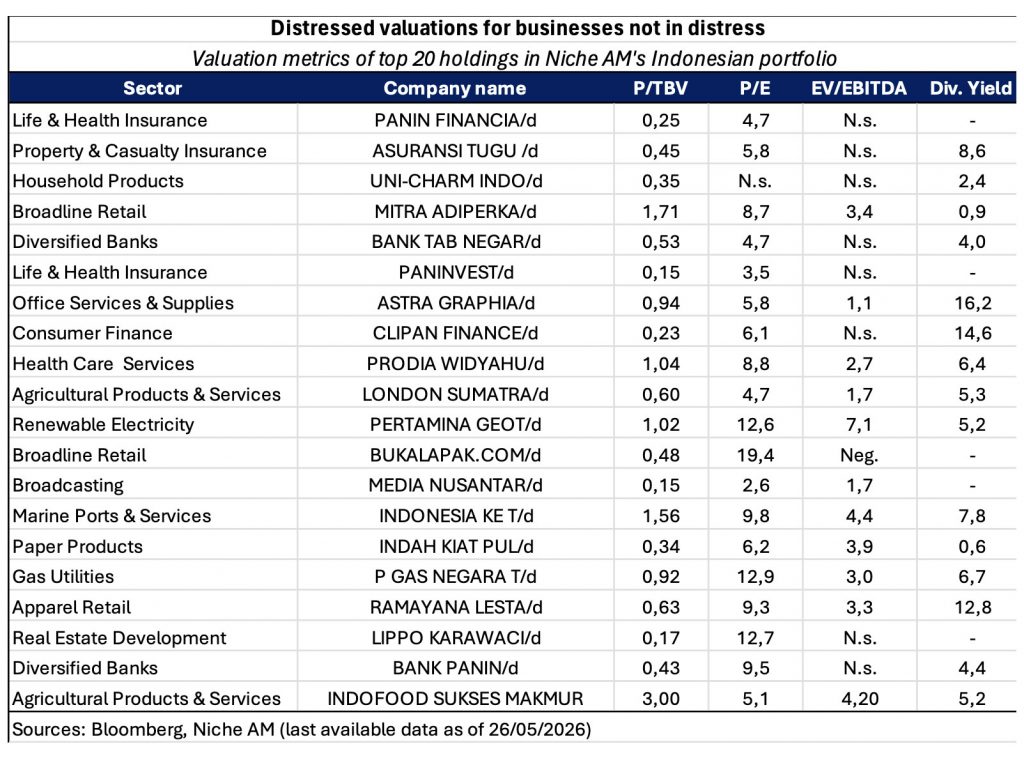
This is not a portfolio pricing moderate risk. This is a portfolio pricing near-terminal distress — in businesses that are not in distress.
To be clear about the investment horizon of our Indonesian thesis: we are not calling an imminent catalyst or a near-term re-rating. We never anticipate this. What we are arguing is that at current prices, the risk-reward over a three-to-five-year horizon is asymmetric to a degree that we find very impossible to ignore.
It must also be noted that Indonesia — with its domestically driven economy, negligible technology hardware exposure, and significant commodity and consumer orientation —
offers genuine diversification and a structural hedge against the concentration risk that now dominates conventional EM exposure.
Conclusion
“The stock market is the only market where things go on sale and all the customers run out of the store” – famously said Warren Buffett.
Indonesia is indeed on fire sale — and investors have already run for the exit. With an equity market below its 1996 level against an economy six times larger with very robust fundamentals; an unjustified discount to peers with equal or greater political risk; a Prabowo presidency that warrants scrutiny but not flight; risks overly discounted in equity prices; and the option of real portfolio diversification away from the crowded global technology and momentum trades – with all this, we are happy to stay in the store and pick up quality assets at a heavy discount.
This is a marketing communication intended exclusively for institutional investors. Please refer to Fund Prospectuses and KIDs before making any investment decision.
Like our Niche Insights? Read more here
Follow us on LinkedIn
Niche Asset Management Limited
Authorized and Regulated by the Financial Conduct Authority
17 Lennox Garden London SW1X 0DB – Registered in England – No. 10805355
Back

