


The Grey Discount — Chapter I
Ageing is the most predictable trend in economics, yet nobody wants to own it
Ageing is the most predictable trend in economics. Everybody who will be eighty, eighty-five or ninety in 2050 has already been born. No adoption curve or technological breakthrough is required. At the same time better access to information and higher incomes mean that consumer tastes and needs are changing: people know more about their own health than any generation before them, earn more, and increasingly want to be tested — when their governments are not already telling them to — in order to catch and treat disease early, or simply to feel, and look, better. They are probably more narcissistic, more anxious and more ambitious: it has been argued that, having largely tamed famine, plague and war, humanity has set itself a new project, i.e. immortality.1
And yet, while these demand drivers are so predictable, the listed companies whose business is to look after those people and those needs — mainly nursing homes, clinics and diagnostic laboratories — sit among the cheapest corners of global equity markets, the United States aside.
The sector has been sold as “grey gold” several times, has bubbled several times, and has never fully delivered. Then came Covid, which created overcapacity in diagnostics and put care homes on the front pages for the worst possible reasons; and then the Orpea affair in France, which erased more than 95% of the value of Europe’s largest operator and tainted everything around it.
What is left is a group of businesses across nursing homes and diagnostics with recovering occupancy, capacity being closed or consolidated, rising testing and treatment volumes, a demographic driver about as predictable as anything in economics, and balance sheets often backed by real estate — priced as though the trend had been cancelled.
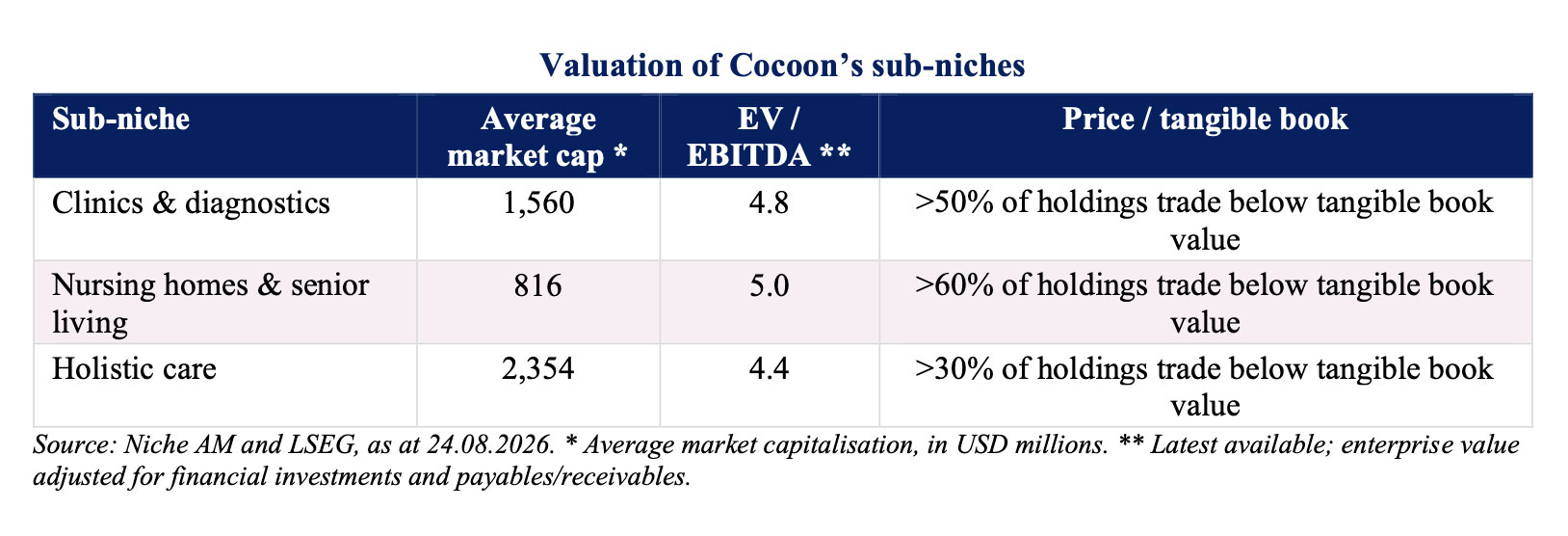
The market pays something close to forty times cash flow for the theme in the United States, when it arrives wrapped in a real estate investment trust.2 What it ignores is the price of ageing everywhere else. Throughout our funds we own several of those companies, valued on average, in the care, diagnostics and holistic care business, that make up the bulk of our holdings, below the value of their tangible assets and on a single digit P/E.
This is the first of three articles on the theme. It deals with nursing homes and senior living, which is where the scandal happened. The second will take up clinics and diagnostics, and the third holistic care (pharmaceuticals, nutrition and cosmetics).
Nursing Homes & Senior Living — The investment thesis in short
Predictable demand. Everyone who will be eighty in 2050 is already alive and counted. No adoption curve, no technology risk, no change in consumer taste is required. Demography is predetermined.
Constrained supply. Senior-housing construction has collapsed, while licensing takes years. Long admission queues and hard licences support occupancy and negotiating leverage, though regulated tariffs limit how fast scarcity becomes price.
A compulsory payer that pays private companies. Several countries now run mandatory long-term care insurance whose liabilities grow automatically with the age of the insured. In Germany private, for-profit, nursing homes represent about 40% of the market; in Korea commercial providers hold three-quarters of the market. The state is the customer, not the competitor.
Mispriced operator risk. The market pays close to forty times cash flow for operating exposure to ageing in the United States and under ten times earnings for the same operating exposure in Japan, Korea and Europe. Scale, liquidity and capital structure explain only part of that valuation gap. The rest is not justified.
Asset backing. Nursing homes often trade below the value of the buildings they own.
How we play it. We are not buying a longevity narrative in itself. We are deep-value investors: we buy cheap, profitable, asset-backed businesses — at multiples that reflect years of reputational damage rather than the quality of the underlying assets.

How a sector became uninvestable
In January 2022 a French investigative book, Les Fossoyeurs (“the gravediggers”), by French journalist Castanet accused Orpea — then the largest private operator of nursing homes in Europe — of systematic neglect of residents and of financial misconduct. The chief executive of eleven years was removed within the month.3
The company’s market value fell from a peak of around €7 billion to below €150 million, and the restructuring that followed effectively wiped out the existing shareholders. What survived trades today as Emeis.3
The damage did not stop at the company accused. Clariane — the other large listed European operator, formerly Korian — fell sharply, even though its management rebutted most of the allegations made about care quality in its own facilities. Swedish, German and Spanish operators de-rated alongside them, in countries the book never mentioned. One investigation, into one company, in one country, repriced the listed care operators of an entire continent.4
Two other things happened at much the same time.
Covid gave the sector the worst advertisement imaginable. Care homes became, in the public mind, the place where the pandemic did its work. Occupancy fell, agency staffing costs surged, and the political salience of the industry went from nil to maximum in a matter of weeks.
Then came interest rates. Care operators are property-heavy, leveraged businesses. They had financed a decade of expansion through sale-and-leaseback, converting freehold into rent. When discount rates tripled, the asset side repriced downwards and the liabilities did not, and management teams spent three years selling real estate into a buyer’s market in order to survive rather than to grow.
The result is a sector that nobody has wanted to own for four years — precisely the condition under which we prefer to buy.
Three structural trends, none of them a forecast
Three structural trends drive our investment thesis — none of them requires anybody to either change their mind about anything or change their behaviour.
1. Demography is a given
There are roughly 830 million people aged 65 or over in the world today. On United Nations projections that number roughly doubles, to about 1.6 billion, by 2050. The over-80s — the cohort that actually consumes care, as distinct from the cohort that merely retires — is expected to triple over the same period, to around 426 million.5
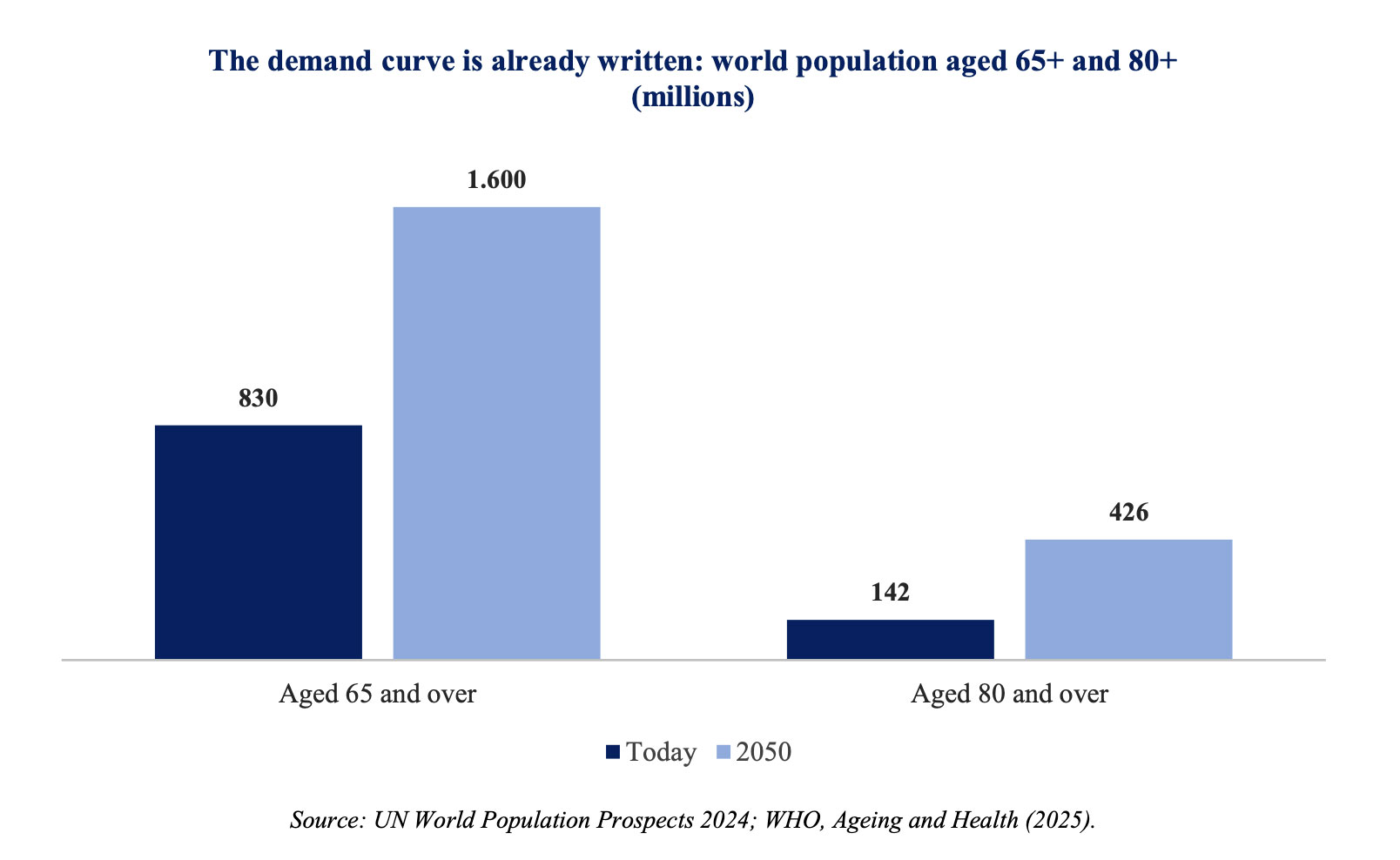
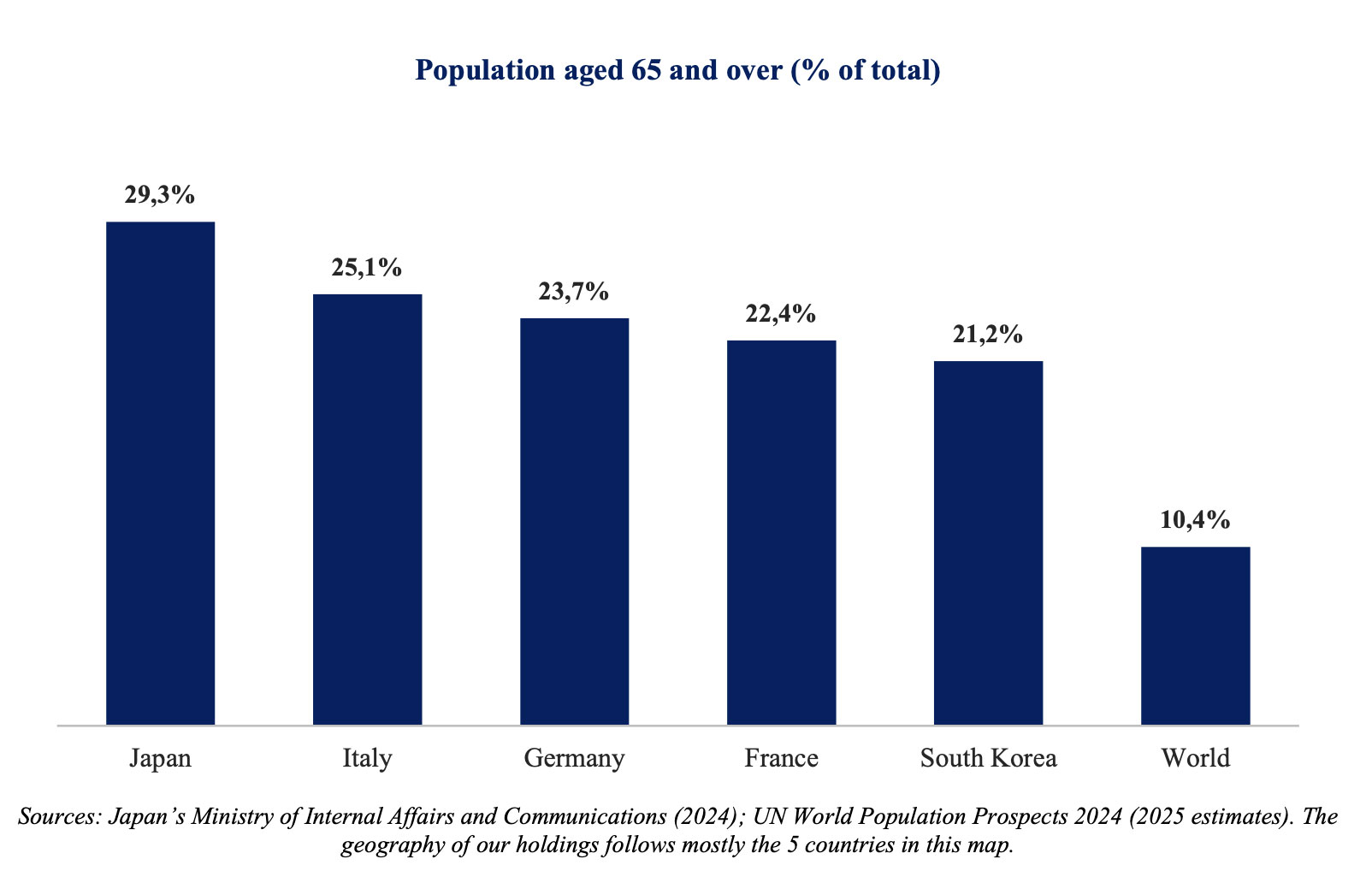
In Europe the number of people over 75 will rise from 66 million to 81 million, or 23% of the population, between 2021 and 2030.6 Japan is already there. Some 36 million people, 29.3% of the population, are over 65. Korea crossed the 20% “super-aged” threshold in December 2024 and stood at 21.2% by the end of 2025 — a transition accomplished in under twenty-five years, and one that continues towards 40% by 2050.7
Unlike other themes, this is one whose addressable market has already been born. Yet, we should be clear that while demography is predetermined, demand is not. What an ageing population actually consumes depends on reimbursement policies, prices, family behaviour and capacity. Demographics set the size of the addressable market; they do not guarantee that anybody gets to sell into it.
Japan — the world’s oldest major economy — is the natural laboratory for this theme. At 29.3% of the population over 65, Japan sits roughly where Italy will be in a decade and Germany shortly after. It has already run the whole experiment: it built compulsory insurance in 2000, opened home care to commercial operators, watched informal family provision fall to about 44% of all care delivered, and discovered that one of the most binding constraints was not money but staff. Whatever Europe is about to learn regarding the economics of elderly care, Japan has already learned. Japanese equities usually trade at a discount for being behind (in corporate governance, shareholder returns, etc). In this sector, perhaps, they trade at a discount for being ahead.
2. More old people means disproportionately more frail old people
Demand for care is not driven by the retired; it is driven by the very old, and it is the very old who grow fastest. The eighty-fifth birthday, not the sixty-fifth, is what fills a nursing or hospital bed.
Underneath that lies the fact that we are adding years to life faster than we are adding health to those years. The distance between how long a person lives and how long they live in good health — what epidemiologists call the morbidity gap — is not closing. It is widening. Global life expectancy at birth rose from 64.6 years in 1990 to 73.8 in 2023, a gain of about nine years. In the meantime, healthy life expectancy rose from 55.9 to 63.1, a gain of about seven. The missing two years went into the gap, which now stands at 10.7 years against 8.8 a generation ago. Life expectancy grew faster than healthy life expectancy in 203 of the 204 countries measured.8
Medicine is extremely good at preventing people from dying and much less good at preventing them from becoming frail. Every heart attack survived, every cancer converted into a chronic condition, every stroke followed by rehabilitation is a person who arrives at eighty-five needing help with washing, dressing and caring. The pharmaceutical industry mostly focuses on that first, survival stage. Our holdings mostly cater instead to the caring and nursing of the “survivors”.9

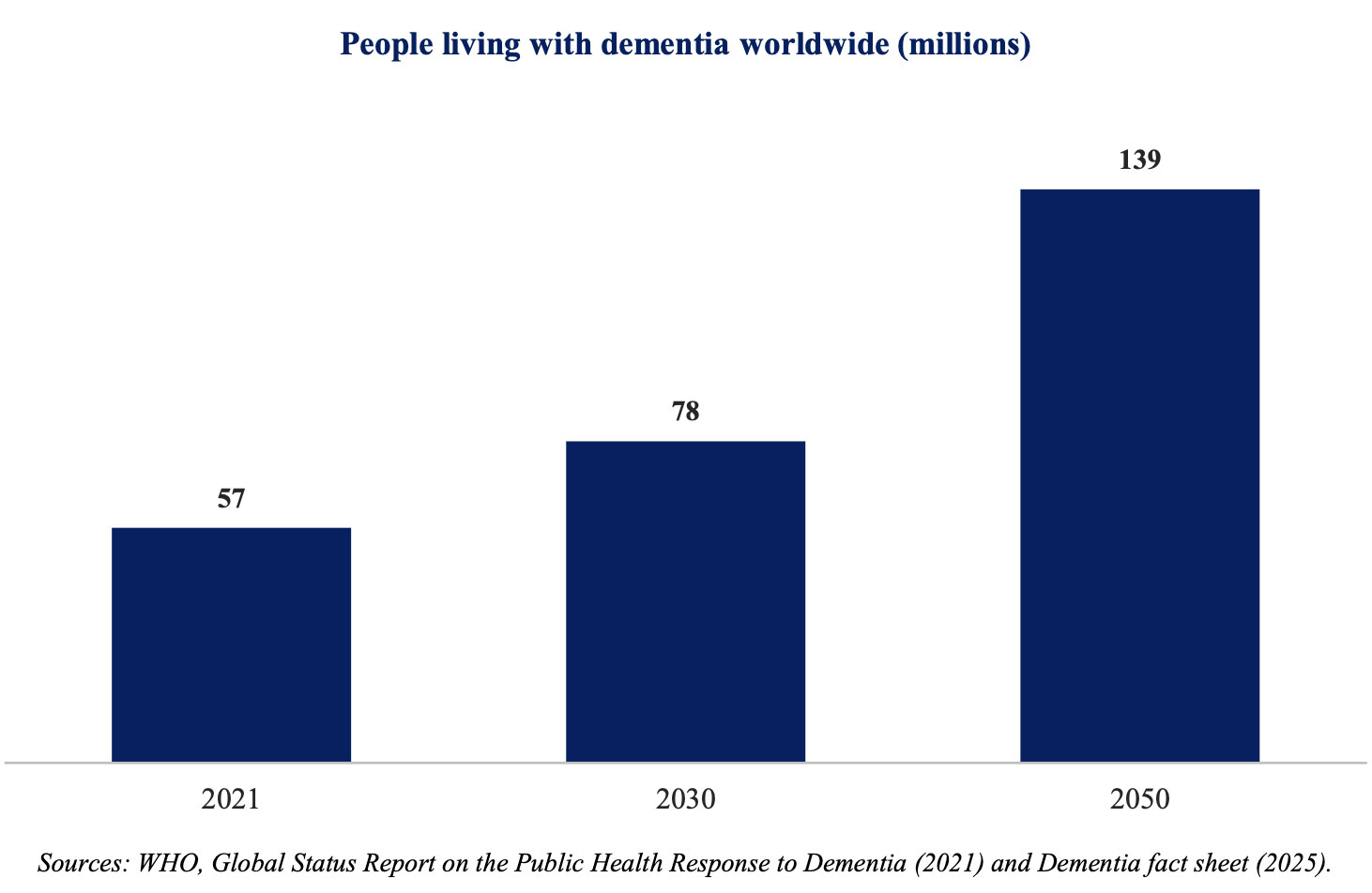
Dementia is the clearest single illustration. The World Health Organization put the number of people living with dementia at 57 million in 2021, rising to 78 million by 2030 and 139 million by 2050, with close to ten million new cases each year. The global cost was estimated at $1.3 trillion in 2019 and is expected to exceed $2.8 trillion by 2030. Roughly half of that cost today is informal care — unpaid work done by family members, averaging some five hours a day.10
3. The family has stopped being the supplier of care
The last figure in the previous section is key. Half the cost of dementia today is carried by families who are not paid for carrying it. That is not a cost that economies have avoided; it is a cost that economies across the world have hidden inside the households. As families shrink (and daughters who provide most of that care move to paid employment), the hidden cost has to be bought from somebody — and at that moment it stops being unpaid labour and becomes the revenue of a nursing home or a clinic. This is one of the mechanisms the ageing theme rests on: the demand does not have to be created. It only has to be transferred.
In Korea for example, the share of older parents supported by their families fell from roughly 19% in the 1970s to under 5% by 2020.11 Fewer children, smaller and more dispersed households, and more women in paid employment together dismantle the unpaid care system on which every society has silently relied. Care that was once provided free and invisibly inside the household is progressively converted into a service bought from a company with a payroll, a licence and, in some cases, a listing. Whether one welcomes that or not is beside the point; it is happening, and it is arithmetic.
Who pays — and who gets paid
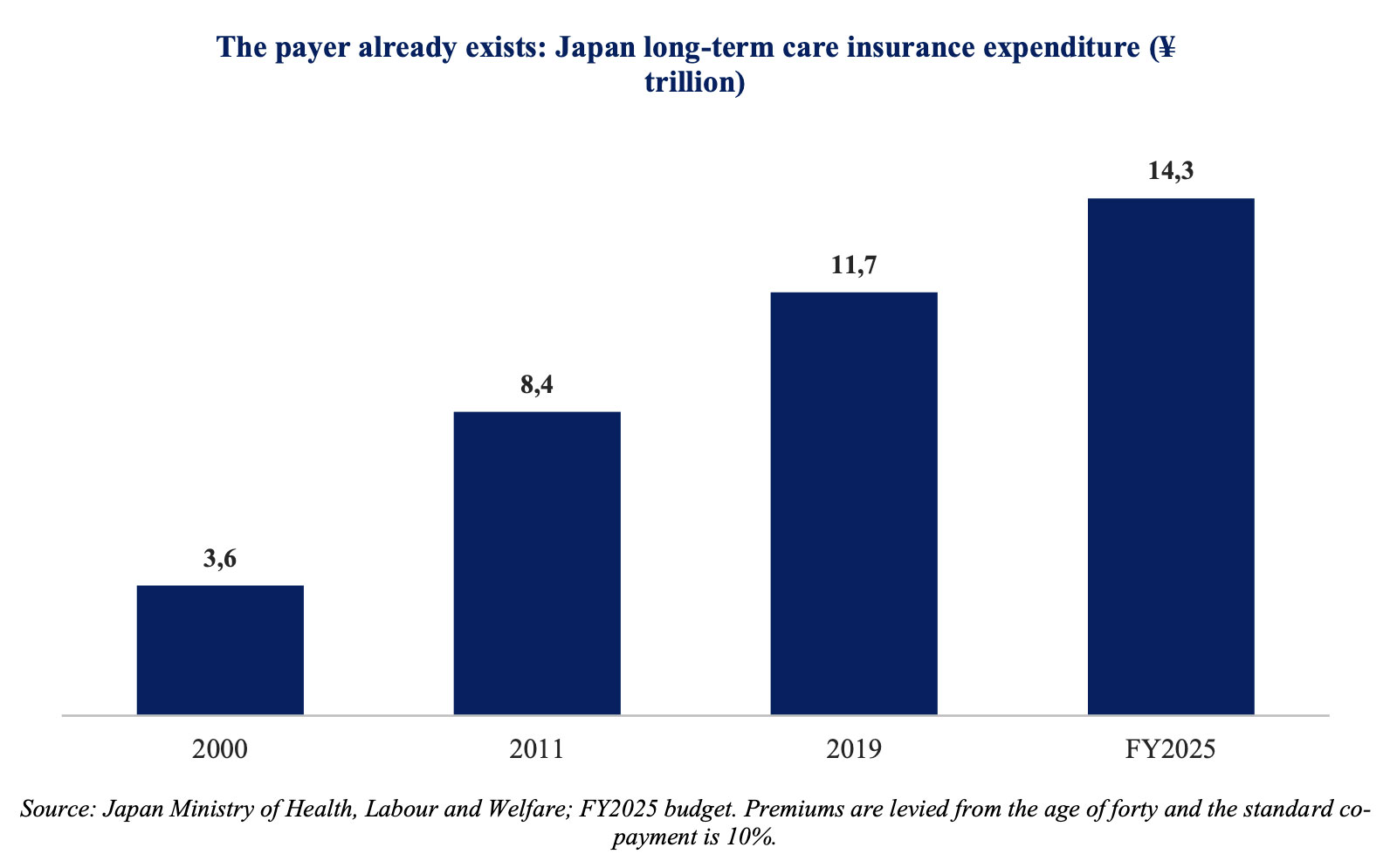
The usual objection to investing behind a social trend is that the capital to fund it (and generate investor returns) may never appear. In long-term care, however, in the markets where we invest, it appeared decades ago.
Japan introduced compulsory long-term care insurance, kaigo hoken, in 2000. It is funded by premiums levied from the age of forty, with a standard co-payment of 10%. Spending has risen roughly fourfold since inception, from ¥3.6 trillion in 2000 to ¥14.3 trillion in the FY2025 budget, around $91 billion.12
Korea followed in July 2008, collecting long-term care insurance as a supplement on national health insurance premiums. Germany has operated the Pflegeversicherung compulsory long-term care insurance since 1995. France funds long-term care through a more fragmented combination of national health insurance, departmental allowances and payments by the resident: the structure differs, the central fact does not, in that a material part of operator revenue is publicly financed.13
None of which would interest equity investors if all the money went to state-owned institutions. But it does not. In Germany a little over half of all German nursing homes belongs to the non-profit welfare associations (principally Caritas, Diakonie and the Red Cross, which remain the sector’s largest owners, and they are clearly not investable) while public ownership is roughly 5%. The balance, about 40%, are instead private for-profit businesses, up from 35% in 1999. Commercial providers account also for some 64% of domiciliary nursing services. In Korea the system was built on private supply from the outset, precisely in order to create capacity quickly, and commercial providers have held around three-quarters of the market ever since. In France the two large, listed operators — Emeis and Clariane — draw a substantial part of their revenue from publicly funded care payments. The state, in other words, is not a competitor in these markets.14
The revenue pool is usually mixed: in Japan the insurance pays for care while the resident pays rent and meals; in France care, dependency and accommodation have three different payers; in Germany the insurance rarely covers the whole cost of a place. What is common to all of them is that a compulsory or statutory payer funds a substantial part of the bill, and does so whatever the economic cycle is doing.
The state is not a competitor. It is a customer.
The supply side (and economics) of nursing homes
Everything so far has been about demand. The other half of the investment case is that supply cannot meet demand, and that this is not a temporary condition.
Barriers to entry are significant.
You cannot open a nursing home the way you open a restaurant. Licensing, planning permission, minimum staffing requirements, inspection regimes and admission to the public reimbursement system can take years and be refused. Switching costs are high: families do compare facilities before admission, and hospitals and insurers do put laboratory contracts out to tender; but moving a frail resident after placement is disruptive and rare, and established sample flows, accreditation and physician relationships are sticky.
These are not commodity businesses — although they have been priced as though they were.
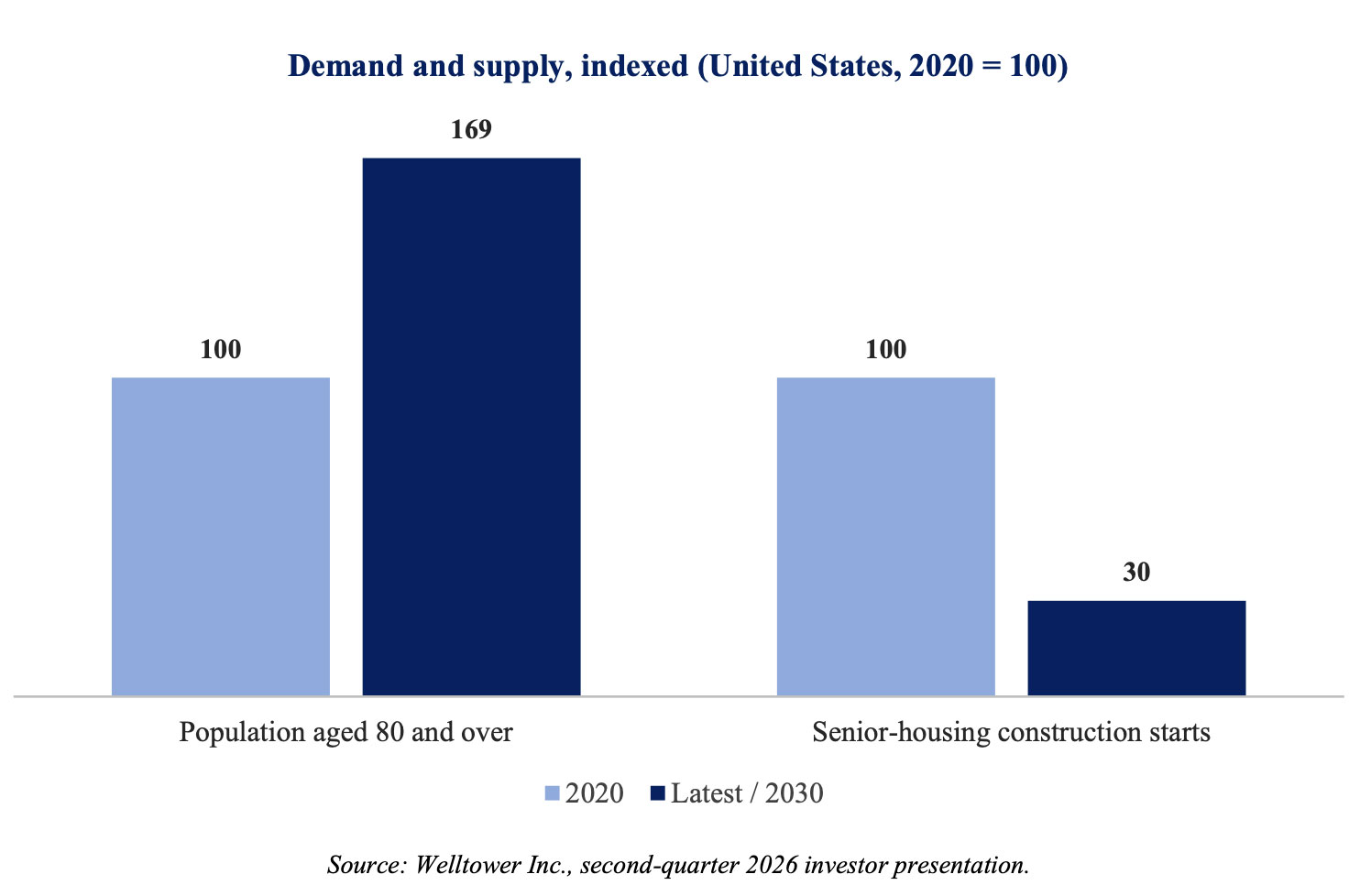
Bed availability is one of the key constraints on the supply side of nursing homes. In the United States, the only market that publishes these data, senior-housing construction starts is expected to fall by about 70% in Q4 2026 from the peak — at precisely the moment the population over eighty enters a decade of 5.4% annual growth (against 1.8% in the decade before). Europe and Japan publish nothing so precise, and we infer that capital was no more available there through the same years. No operator we follow has been building.15
In Japan, applications for places in subsidised (non-profit) nursing homes face queues of two to five years in urban areas.16 To the extent that under-capacity delays access to the non-profit institutional sector, demand is redirected towards fee-based, private, nursing homes and care operators.
Then labour, which is a binding constraint everywhere and cannot be solved by capital. Japan’s ministry plan requires the care workforce to grow from about 2.15 million in 2022 to 2.72 million by 2040 — an additional 570,000 people — in a country whose working-age population is shrinking by roughly half a million a year. There are currently around four vacancies for every applicant in Japanese care work, and more than a fifth of care workers are themselves over sixty. Korea reported a shortfall of some 190,000 nursing staff in 2023. Meanwhile the demand for that labour intensifies rather than merely grows: the over-75s are certified as needing care at six to seven times the rate of the 65-74 cohort, and Japan’s entire baby-boom generation crossed seventy-five in 2025.17
The obvious escape from a labour shortage is immigration, but this route is being closed off at precisely the wrong moment almost everywhere in the developed world. Japan has been opening its skilled-worker route for care work, but the scale is far below what the ministry’s own 2040 arithmetic requires. Removing the cheapest source of labour from a sector whose largest cost line is payroll raises wages, and whether that reaches the operating margin depends entirely on whether fees can follow. Of course, labour shortages make capacity harder to add for anybody: a competitor cannot open a new facility that it cannot staff, and potential new competitors face higher barriers to entry.
The other possible answer to a labour shortage is technology, via for example monitoring sensors and transfer assistance: it lowers the staffing ratio a facility needs, thus protecting private operators against wage inflation. Yet, over the longer term, technology is also a threat to fee-based nursing homes (and in fact it appears as a risk to the investment thesis in the risk section below), as it could substitute for beds altogether. The two effects would eventually pull in opposite directions and we would not pretend to know the net.18
Overall, persistent queues, difficult licensing and labour-constrained supply support high occupancy and give the operator some negotiating leverage — with the payer, and with private-pay residents. Of course, they do not confer full pricing power, because in a regulated sector the speed at which scarcity converts into price depends on tariff indexation, on the payer’s and public willingness to fund it and the (sensitive) politics around the issue. Yet, the last three years demonstrated that the conversion does happen — if slowly — as fee increases were passed through across Europe and Japan. Rising prices on frail old people is always politically challenging, but such increases tend to go through anyway, because the alternative for the payer and the family is often no bed at all.
Dementia and other high-acuity care command the highest monthly rates in senior living and the lowest price sensitivity, for the plain reason that a family with a parent who can no longer safely be left alone is not shopping on price. It is the least discretionary service in an already non-discretionary sector.
The valuation gap between the US and the rest of the world
Welltower, the largest senior-housing real estate investment trust, carries a market capitalisation above $160 billion and trades at close to forty times its own raised guidance for 2026 normalised funds from operations — on some estimates around twice its net asset value. Its investment case is partly based on a chart of the American population over eighty19 and is arguably evidence that the demographic curve is already converting into operating results today, rather than in some actuarial future.
We express no view on whether that is the right price for Welltower. We simply observe that the same demographic chart bought in Tokyo, Seoul, Paris or Jakarta is available at under ten times earnings and below the value of its tangible assets, which are the average multiples across our holdings in this niche.
Why the valuation gap? Part of it is probably well deserved, and it has to do with scale, liquidity, capital structure and access to capital. Also, Welltower is in part a real estate landlord with no old people’s care operation, where it collects a contracted rent and passes wage inflation, staffing shortages and occupancy risks to the nursing home operator, so some of its cash flow genuinely does deserve a higher multiple than the cash flow of the business absorbing those risks.
Yet, Welltower’s senior-housing operating portfolio — the structure in which the trust takes the operating economics, wage inflation included, rather than collecting a fixed rent — now generates about 75% of same-store net operating income, and management has stated its intention to further raise the focus on senior-housing. In other words, the most expensively valued vehicle in the sector in the world has spent several years deliberately moving towards operator risk and has been re-rated upwards while doing it.20
The bottom line: equity markets seem to capitalise operating exposure to ageing generously when it arrives through a large, liquid, real estate, US platform, and capitalise the same occupancy and labour risk far less generously when it arrives through smaller Asian and European operators.
A brief overview of our ageing thematic portfolio
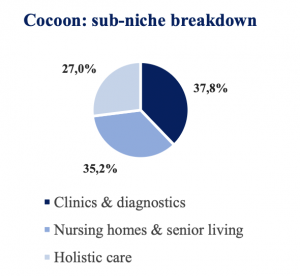
We invest in the ageing theme through all our portfolios, and we have a dedicated niche (named “Cocoon”) within our Asian Value Niche fund.21
The niche is built on three sub-niches.
Nursing homes and senior living
Operators in Europe, Japan and New Zealand. The European names are emerging from the crisis with visible operating momentum.22 The Japanese names never de-rated on scandal, because there was none — they de-rated on investor neglect.
Clinics and diagnostics
Laboratory networks, testing companies and diagnostic and med-tech equipment makers, principally in Japan, Korea and Indonesia. The second article in this series is devoted to them.
Holistic care (pharmaceuticals, nutrition and cosmetics)
Treating ageing as a disease rather than an inevitable natural process is one of the most disruptive paradigm shifts in modern medicine. For centuries healthcare has been reactive — waiting for people to develop age-related diseases and then treating those conditions. The new medical frontier, known as geroscience, aims to target the underlying biological mechanisms of ageing itself. Geroscience is also reshaping cosmetics.
The beauty industry has entered the era of “skin longevity”. Rather than masking the flaws of old age, modern formulations aim to treat the underlying cellular biology that causes skin to age.
Finally, in the context of geroscience, nutrition is no longer viewed merely as eating well, but as a way to reprogram the molecular hallmarks of ageing.23
What we do not own matters as much. We own no US healthcare REITs: the right exposure at the wrong price. We own no unlisted senior-housing developer, because we invest in public equities and are not paid to take illiquidity risk on a promise. And we own none of the fancy longevity-clinic wellness names, which are concepts with a story rather than proven businesses. If the wellness bubble deflates, our holdings are unaffected.
How we play it
We are not buying a longevity narrative in itself. We are deep-value investors: we buy cheap, profitable, asset-backed businesses, and it happens that a cluster of them today sits in the business of caring for and testing the old and sick. We are buying operators and laboratories at multiples that reflect years of reputational damage rather than the quality of the underlying assets.
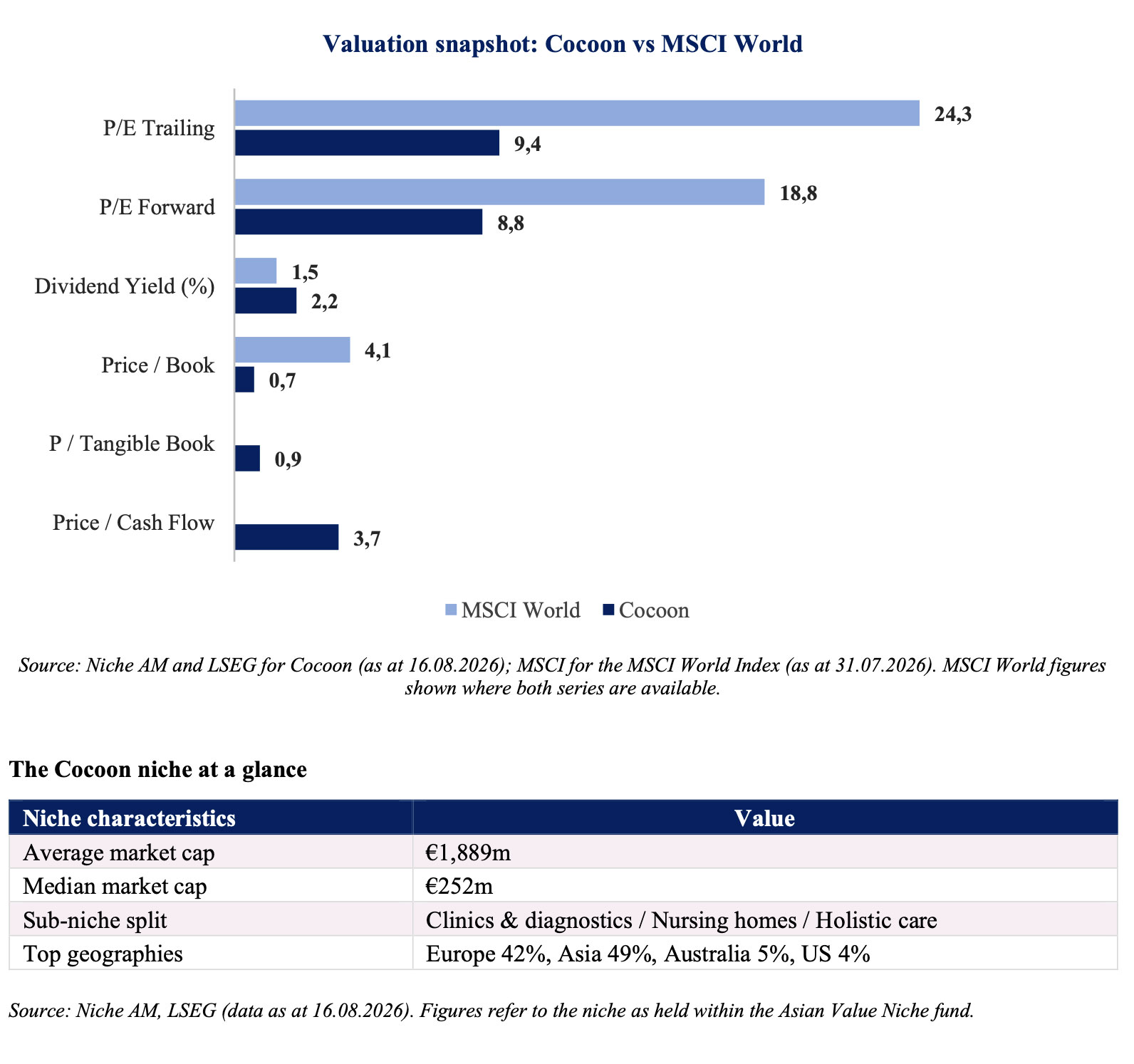
We require property ownership, net cash, or asset cover that does not depend on refinancing. Paying at or near tangible book does not eliminate execution risk, but provides downside support, especially if we turn out to be wrong about execution at individual holdings. We are not paying for any turnaround in advance. Our Cocoon niche trades at well under half the earnings multiple of the MSCI World index, at less than four times cash flow, and below tangible book. Several holdings trade below the value of their property alone or, in Japan, below net cash.
Governance is screened explicitly. Orpea taught the sector, us included, that in a business whose product is the care of vulnerable people, reputational risk is a serious balance-sheet and valuation risk, as well as an even more serious moral issue.
Consistent with our house style, the niche is highly liquid and diversified: tens of positions across three sub-niches and five countries are exposed to genuinely different drivers: nursing homes turn on reimbursements; clinics and laboratories on statutory testing volumes; holistic care to new science frontiers and immense all-age consumer demand. They do not fail or behave together.
The niche’s geographic exposure is also key. The industry is extraordinarily fragmented, most of all in Japan and Korea, where there is no cap on the number of providers and the market is dominated by individual and family operators. Scale could bring centralised purchasing, staff pooling across sites, occupancy management, and the ability to spread the compliance function. This means that markets like Japan and Korea could well see a wave of consolidation, thus helping drive valuations further. The operators and laboratories in Asia and Europe that make up this niche have a median market capitalisation of €252 million.
How our ageing thematic portfolio differentiates from the other vehicles exposed to the theme
The ageing theme is not unavailable to European investors.
However, the other industry vehicles hold mostly large cap names, have much higher valuation multiples than our deep value portfolio24 and focus mostly on pharmaceuticals, retirement finance, the spending of wealthy older consumers, and the automation required to replace ever fewer young workers. All businesses that benefit from people living longer, but not really “caring for” the people living longer (with perhaps the exception of pharmaceuticals).
In a sense, the market has not really ignored ageing: it has decided which version of ageing it is willing to own — the drugs that lengthen life, the institutions that finance the extra years’ consumption and the goods consumed during those extra years, rather than the care operators, clinics and laboratories that handle what happens when life gets longer (and harder). Which is instead what we do own via our Cocoon niche.
None of the above is meant to deride the other investment vehicles in the industry — we just want to make clear how we are different.
Why now?
We are not in the business of timing entries and exits. The question worth answering is narrower: what, if anything, has changed.
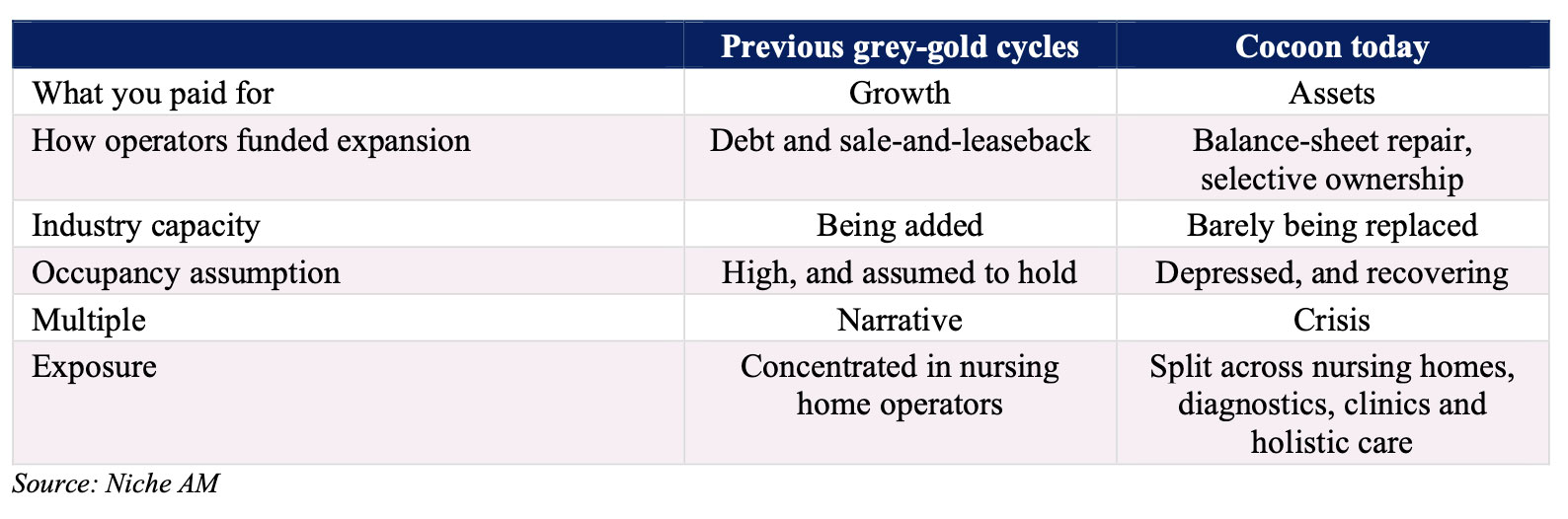
What has changed is that the operational evidence has turned while the multiple has not.
Occupancy across the European operators is back at or near pre-pandemic levels, and occupancy is the variable that matters disproportionately here. A care-home incurs most of its property, management and minimum-staffing cost whether a room is filled or not, so once a minimum level is covered an additional resident arrives at a contribution margin far above the facility average: the operating leverage sits in the last few points of occupancy, which are precisely the points now being recovered.
Fee increases have also been passed through. Agency staffing costs, the single largest source of margin damage during Covid, are normalising. Balance sheets have been repaired through disposals and capital increases. The rate cycle has stopped working against property-backed businesses. And, as mentioned above, no new capacity has been financed for years, so it cannot arrive quickly even if it were ordered today.
It is fair to ask what makes this entry point different from the earlier ones, given that this sector has been sold as “grey gold” before and disappointed every time. The honest answer is that almost nothing about the demographics has changed. What has changed is everything about the price and the balance sheet.
Investment conclusion
We are making no argument about how societies ought to look after their old. Nor are we claiming to have the only or best investment vehicle to play the ageing theme in the industry. Our Cocoon vehicle is just one (different) way of providing leverage to the ageing niche, and it rests on demography, on the collapse of unpaid family care, on funding mechanisms that already exist and are already compulsory — and, above all, on valuation.
The market threw out a structural theme along with the scandal that briefly surrounded it. What is left is cheap, asset-backed and, at last, operationally improving. The need for old people’s care is not in question. Its conversion into profitable growth is — and today’s prices assume far too little of it.
Risks to the investment thesis
Five developments could erode the case. In each case, though, the downside is limited by the kind of businesses we own: cheap, asset-backed, frequently trading near or below the value of their property.
1. Care moves home. Domiciliary care, remote monitoring and AI-assisted support may substitute for beds. It is usually cheaper, and most older people would prefer it: surveys consistently find a strong preference for “ageing at home” vs. nursing homes.25 Yet home care is also a service bought from a company rather than provided free by a daughter or son, so the migration from unpaid to paid care continues either way. The highest-acuity residents, and most advanced dementia, cannot be managed at home at acceptable cost. And the diagnostics half of our Cocoon niche is indifferent to where care is delivered.
2. The payer squeezes. These are regulated revenues, in large part publicly funded, and the political temptation to for example freeze tariffs below cost inflation is often high. Labour costs, meanwhile, rise structurally in shrinking workforces, and immigration restrictions could remove the cheapest source of labour supply. Payroll is the largest single cost line in every operator we own. If wage inflation were to run persistently ahead of tariff indexation, margins would compress faster than occupancy could repair them, and there could not be a compelling reason why a public payer under fiscal strain should index tariffs to a nursing-home’s wage bill. This is the risk we would rank first in terms of probability or impact. Yet tariffs were in practice indexed upwards through the inflation shock of the last 3 years; agency-staffing costs are already normalising; and we own asset-backed balance sheets rather than pure operating margins.
3. Another scandal. The product here is the care of vulnerable people, and governance failure is a permanent tail risk that seems to reprice the whole sector and not merely the offender — as Orpea demonstrated. We mitigate it in the only ways available: diversification across three sub-niches and five countries, with no position representing a material weight of the portfolio.
4. Healthy ageing. Future cohorts may reach eighty in better condition than their parents did, delaying the onset of dependency and compressing disability into a shorter period at the end of life. If that happens, care intensity at any given age falls, and the number of people over eighty overstates the number of people who need care. It is worth recalling that the largest test of the hypothesis, published in July 2026 and set out earlier in this article, found the opposite in 203 countries out of 204.26 We would also distinguish sharply between two claims: that care needs arrive later, which is plausible and would genuinely compress the revenue pool at the margin, and that they disappear, for which there is very little evidence. Compression of morbidity moves the demand curve to the right. It does not delete it.
5. Demography is not a business plan. Some of our holdings are turnarounds: they require management teams to rebuild occupancy, margins, balance sheets and public trust at the same time, and turnarounds of course can fail. The Japanese and Korean holdings need less repair but more patience, since nothing obliges a cheap, well-capitalised domestic company to re-rate on any particular timetable. Our defence is not confidence in management. It is the entry price and the asset backing: paying close to tangible book for businesses whose demand is not in question is what allows us to be wrong about execution at selected holdings and still be right about the niche.
Sources & notes
1 See for example Yuval Noah Harari, Homo Deus: A Brief History of Tomorrow (2015).
2 The reference is to Welltower Inc., the largest listed owner of senior housing and the vehicle through which most capital expresses this theme in the US — it is discussed later in this Niche Insight. Nothing in this article is a recommendation regarding Welltower, which is not a holding of the niche.
3 Victor Castanet, Les Fossoyeurs (Fayard, January 2022); Savills, UK & European Care Home Investment (1 July 2025)
4 Savills, “Green shoots emerge in troubled European care-home sector” (October 2025).
5 United Nations, World Population Prospects 2024; UN DESA Population Division; Our World in Data (2024); WHO, Ageing and Health, 2025.
6 United Nations population data.
7 Japan’s Ministry of Internal Affairs and Communications / Statistics Bureau (2024); Carnegie Endowment, “Governing Aging Economies: South Korea and the Politics of Care, Safety, and Work” (March 2026).
8 “Global, regional, and national trends in the morbidity gap”, The Lancet Public Health, 21 July 2026; analysis by the Institute for Health Metrics and Evaluation, senior author Christopher Murray; Jonathan Guthrie, Financial Times (13 August 2025).
9 There is nothing to celebrate in frailty, and we take no satisfaction in a business model that depends on it. The care of the very old is work that has to be done by somebody, it is chronically underfunded and undervalued almost everywhere, and the companies that do it well deserve capital rather than the neglect they have received. Our argument is simply that a structural and entirely foreseeable shift in where that care is provided — from the family to the balance sheet of a licensed company — is not reflected in the price of the companies concerned.
10 World Health Organization, Dementia fact sheet (2025) and Global Status Report on the Public Health Response to Dementia (2021); Alzheimer’s Disease International, Dementia Statistics.
11 Korea: family-support data cited in Age and Ageing, vol. 52 (2023). Japan dependency ratio, EU births and global fertility: Valentina Romei, “Five ways demographics are transforming the world economy,” Financial Times (6 March 2026), drawing on UN World Population Prospects 2024, OECD and ILO data.
12 Japan’s Ministry of Health, Labour and Welfare; FY2025 budget.
13 Korea’s National Health Insurance Service; Germany’s Bundesgesundheitsministerium; France’s Caisse nationale de solidarité pour l’autonomie (CNSA)
14 Germany’s Statistisches Bundesamt care statistics, as analysed in Ageing International 40 (2015); Korea: Jeon & Kwon (2017), in Journal of International and Comparative Social Policy (2022); France: emeis and Clariane annual reports.
15 Welltower Inc., second-quarter 2026 investor presentation (July 2026).
16 Japan’s Ministry of Health, Labour and Welfare surveys of applications for admission to nursing homes; Japan Times; Akiya Japan, June 2026. Waiting lists measure applications rather than individuals and some applicants appear more than once, so the figure should be read as an order of magnitude for unmet demand rather than a precise count.
17 Japan’s Ministry of Health, Labour and Welfare – 9th Long-Term Care Insurance Business Plan (2024); Geriatrics & Gerontology International, 2023; Long-Term Care Insurance Business Status Report; Journal of International and Comparative Social Policy, 2022.
18 Japan’s Ministry of Health, Labour and Welfare subsidy programmes for care technology and recruitment, FY2026; Valentina Romei, “Five ways demographics are transforming the world economy,” Financial Times (6 March 2026).
19 Welltower Inc. company filings; Bloomberg. Multiples for real estate investment trusts are quoted on funds from operations and are not directly comparable with the price-to-earnings ratios of operating companies; the comparison is made to illustrate the difference in market enthusiasm, not to equate the two metrics.
20 Welltower Inc., first- and second-quarter 2026 results and investor presentations.
21 The niche takes its name from Cocoon, the 1985 film in which a group of residents of a Florida retirement home swim in a pool that has been used to store alien cocoons and find their vitality restored.
22 emeis, first-quarter 2026 trading update (May 2026); Savills, UK & European Care Home Investment (July 2025).
23 Carlos López-Otín, Maria A. Blasco, Linda Partridge, Manuel Serrano and Guido Kroemer, “The Hallmarks of Aging”, Cell 153(6), 6 June 2013, which set out nine hallmarks and founded the field; and “Hallmarks of Aging: An Expanding Universe”, Cell 186(2), 19 January 2023, which extends them to twelve. Whether ageing itself should be classified as a disease remains contested, not least at the World Health Organization; we return to this issue in the third article of this series.
24 Blackrock’s iShares Ageing Population UCITS ETF, tracking the STOXX FactSet Ageing Population index, trades at about 18.1 times earnings and 2.34 times book value as of Blackrock’s own published figures as at late July 2026.
25 Jonathan Guthrie, “What are my chances of ending up in a care home?”, Financial Times (13 August 2025); Valentina Romei, “Five ways demographics are transforming the world economy,” Financial Times (6 March 2026).
26 The compression-of-morbidity hypothesis originates with James F. Fries, “Aging, natural death, and the compression of morbidity”, New England Journal of Medicine 303 (1980). Subsequent evidence is mixed: see the WHO World Report on Ageing and Health and “Global, regional, and national trends in the morbidity gap”, The Lancet Public Health, 21 July 2026.
Legal disclaimer
This document, together with any presentation and related material, is intended exclusively for marketing and information purposes. It is not a legally binding document, contains no representation and does not constitute an offer or invitation to invest in any of the funds of Niche Asset Management Ltd. (the “Fund”). Furthermore, it does not constitute a solicitation for any such offer or invitation, nor may it be regarded as part of it or of its distribution in connection with any contract relating to the Fund. This document, any presentation made in conjunction with this document and any related material are preliminary and for information purposes only. They do not constitute an offering memorandum, contain no representation and neither constitute nor form part of an offer or invitation to subscribe for any of the Niche funds (each, the “Fund”). Furthermore, they neither constitute nor form part of any solicitation of such offer or invitation, nor do they (or any part of them), nor the fact of their distribution, form the basis of, or may be relied upon in connection with, any contract relating thereto. The information contained in this report document has been compiled solely by Niche Asset Management Ltd (known as “Niche AM”), authorised and regulated by the Financial Conduct Authority (RN783048) and registered in England and Wales 10805355. The information and opinions contained in this document are not intended to be complete and may be subject to change at any time. No representation, warranty or undertaking, express or implied, is given as to the accuracy of the information or opinions contained in this document, and Niche Asset Management Ltd and/or its partners accept no liability for the accuracy and completeness of the information. Investments in the funds are subject to market risks, including the potential loss of capital.
The Fund’s investment strategy is speculative and entails a significant risk of losing part or all of the capital invested. Market, political, counterparty, liquidity and other risk factors may have a significant impact on the Fund’s investment objectives, while past performance is neither a guide to nor indicative of future results. The distribution of this document and the offering of the Fund’s units may be restricted by law in certain jurisdictions, and accordingly anyone coming into possession of this document should be aware of and comply with any applicable laws or regulations. Niche AM’s funds are not yet available for distribution in all countries. Prospective investors are invited to contact Niche AM to verify the countries of registration. Any failure to comply with these restrictions may constitute a violation of the laws of such jurisdiction. The reproduction of this information, in whole or in part, without the prior consent of Niche AM is also prohibited. This document may be communicated or passed only to persons to whom Niche AM is permitted to communicate financial promotions pursuant to an exemption provided under Chapter 4.12 of the Conduct of Business Sourcebook (“COBS”) (“Permitted Recipients”). Furthermore, no unauthorised person may communicate this document or otherwise promote the Funds or the units therein to a person in the United Kingdom, unless that person is (a) a Permitted Recipient (b) a person to whom an authorised person is permitted to communicate financial promotions relating to the Fund or to promote the Fund under the COBS 4.12 rules applicable to that authorised person. The securities mentioned in this document have not been registered under the Securities Act of 1933 (the “1933 Act”) or under the securities laws of any other US jurisdiction.
Such securities may not be sold or transferred to US persons unless such sale or transfer is registered under the 1933 Act or exempt from such registration. This document is a marketing communication intended exclusively for professional investors. Prospective investors are advised to read carefully the Prospectuses and the Key Investor Information Documents (KIID) for all details, including risk factors and fees, before making any final investment decision.
Prospectuses, supplements, KIIDs and a Summary of Investor Rights are available free of charge at https://nichejungle.com/regulatorydocuments and at https://nicheam.com/legal.
Do you enjoy our Niche Insights? Read more here
Follow us on LinkedIn
Niche Asset Management Limited
Authorised and regulated by the Financial Conduct Authority
17 Lennox Garden London SW1X 0DB – Registered in England – No. 10805355

