


Do Emerging Markets still provide diversification?
The region does, but the indices don’t
For decades, investors have turned to emerging markets for exposure to alternative economies, sectors or themes — commodities, demographics, the rise of the middle class, etc. — or for exposure to valuations that stood apart from elevated multiples in developed world stocks. That proposition has quietly eroded.
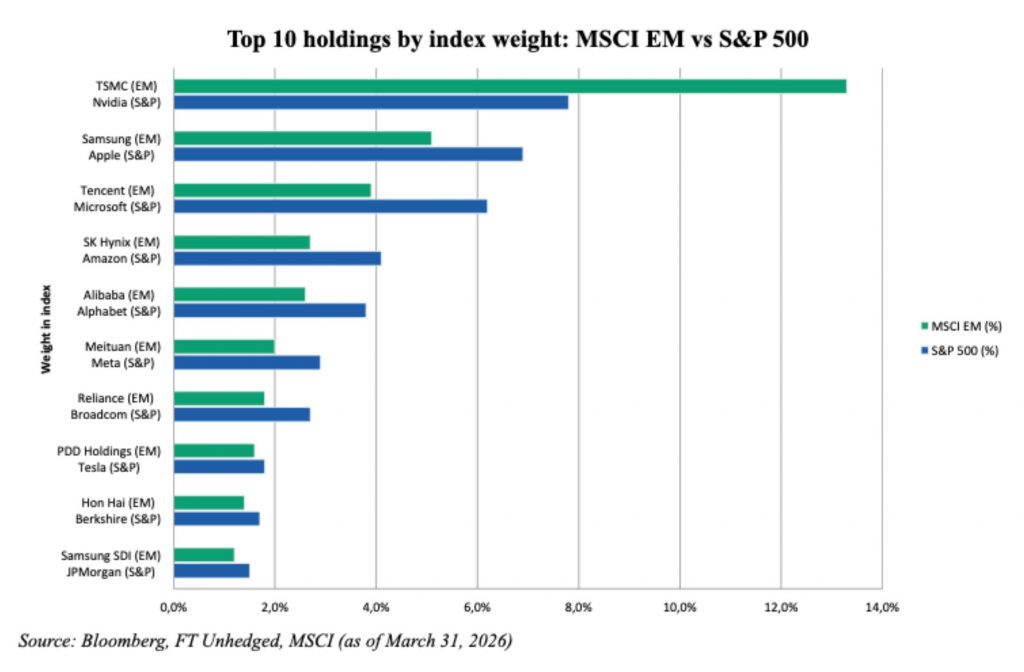
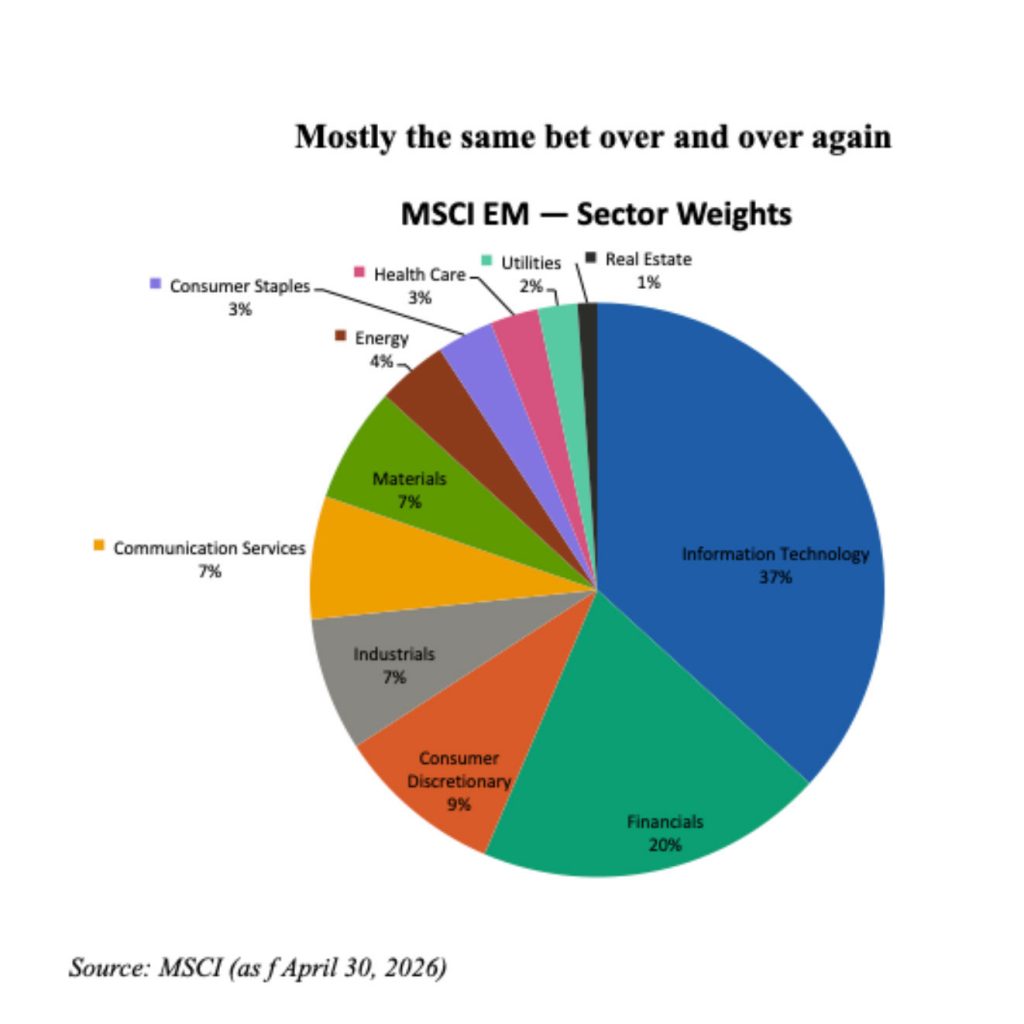
As recently highlighted by this FT article, just three chipmakers — TSMC, Samsung and SK Hynix — now account for almost 25% of the MSCI Emerging Markets Index. The entire IT sector has grown from under 15% of the benchmark a decade ago to its current 37%, leaving the index’s fate closely tied to the same factor that drives US equity markets: artificial intelligence enthusiasm.
The problem is not only sectoral.
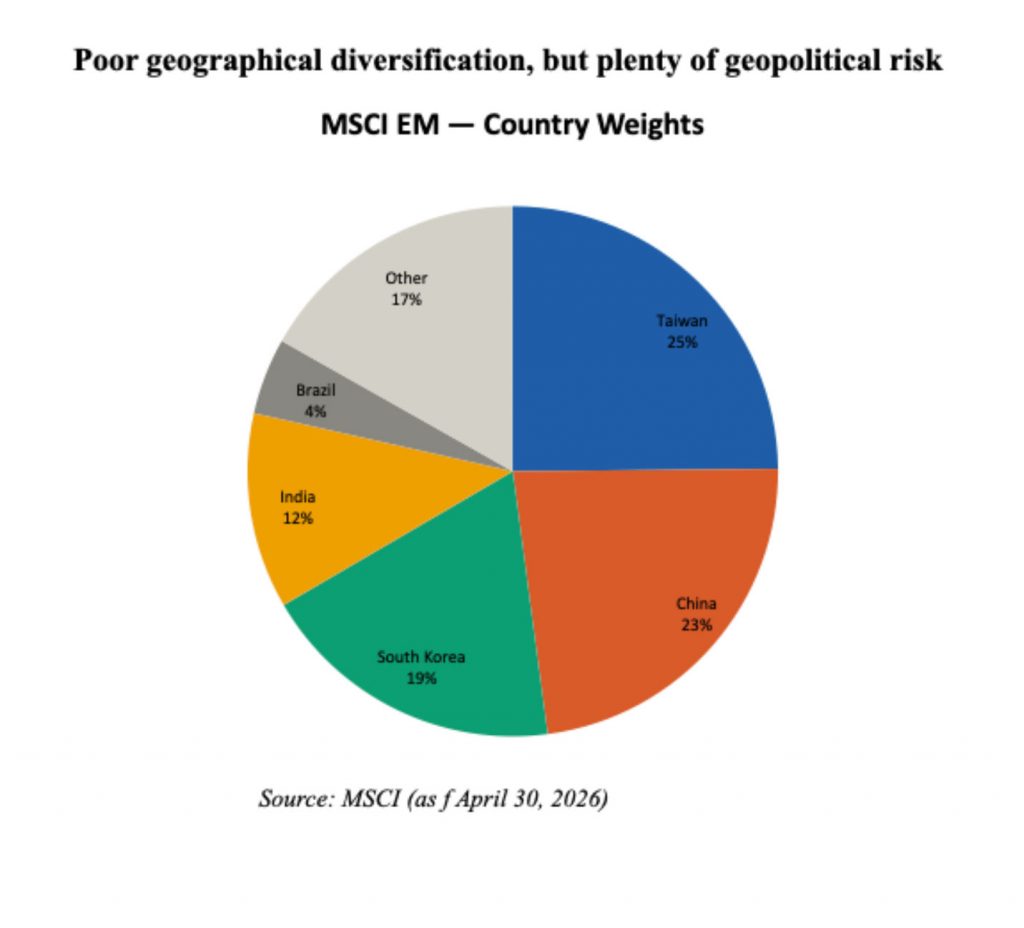
The index is equally concentrated geographically: just 3 countries – Taiwan, China and India – account for over 60% of the MSCI EM. This matters for two distinct reasons. China (including its Hong Kong-listed constituents) and Taiwan carry high geopolitical risks that are difficult to price. India, meanwhile, trades at valuations that have long since departed from the emerging market discount that once justified the region’s inclusion in global portfolios.
For an investor holding a global equity portfolio alongside a standard, passive, emerging market fund, the diversification benefit has become largely illusory. What was once a distinct asset class has become, in practice, a combination of two concentrated bets: a high-beta play on the US AI trade, and an unhedgeable exposure to the geopolitical fault line running between China and the West.
The role of passive investing
Understanding why EM indices have converged with US equity markets requires recognising the role, among other factors, of passive capital flows. ETFs are clearly composed of the largest and most liquid constituents. As those stocks rise, their index weights increase, attracting further passive inflows — a self-reinforcing dynamic that has steadily reshaped the composition of all benchmarks, including emerging market indices.
This mechanism does not allocate capital according to value, diversification or fundamentals. It rewards size, liquidity and, above all, momentum. The consequence is emerging market indices that now reflect the same momentum-driven concentration visible in the S&P 500, rather than the diverse exposure to local economies, commodities, infrastructure, demographics and domestic consumption that once justified the region’s role in a balanced portfolio.
The “real” emerging market economy — the Indonesian agricultural company trading at a huge discount to the value of its estate, the Korean domestic retailer ignored by foreign investors, or the Philippine telecom with a high-growth and lucrative payment business — is largely absent from these indices and therefore absent from the capital allocated to them. And it is in precisely these neglected segments that genuine diversification, and the potential for long-term value realisation, are most likely to be found.
The dot-com precedent
The current configuration of global equity indices is not without historical precedent. At the peak of the dot-com bubble in March 2000, Information Technology represented approximately 32% of the MSCI World Index. The narrative driving that concentration seemed similarly compelling: the internet was transforming every aspect of the economy, productivity gains were structural, and the technology companies leading this revolution deserved premium valuations.
Over the subsequent decade, the IT sector’s weight in the MSCI World fell from 32% to roughly 12% by 2010 — not because technology ceased to matter, of course, but because valuations had run far ahead of earnings. The reversion was painful and prolonged. Investors who had concentrated in the sector via the index endured a decade of underperformance against sectors that had been neglected during the boom years — energy, materials, financials. Exactly the same value-oriented exposures that benchmarks are, again, ignoring today.
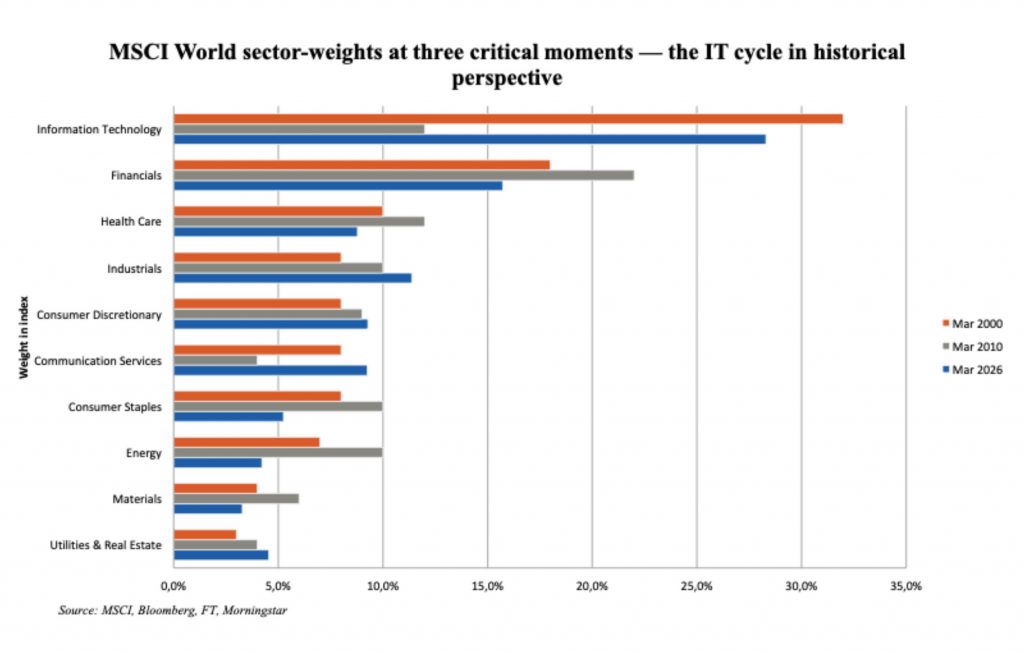
Today, IT accounts for approximately 28% of the MSCI World, more than double its weight in 2010 on the back of the AI cycle. The fundamental quality of today’s technology leaders appears to be significantly higher than in 2000 and the AI cycle may have further to run, but the question of concentration risk is structurally separate from the question of whether technology is a good business.
We are not making a market or sector timing call. We are just arguing that a portfolio that is exposed to the same factors — technology, semiconductors, AI — across its domestic equity, global equity, and emerging market equity allocation, has far less diversification than it appears to have. And more often than not, the discovery of this portfolio feature tends to happen at the worst possible moment.
The “real emerging markets” that are missing in the indices
Emerging markets host thousands of listed companies across a broad spectrum of sectors, sizes and uncorrelated drivers. The vast majority never appear in benchmark indices. They are too small for large ETFs, poorly covered by sell-side analysts, and outside the narratives that attract institutional capital.
What makes these overlooked segments genuinely different is not just their geography, but the economic forces that drive them. They do not move because Nvidia’s Jensen Huang raises guidance or boards a last-minute flight to China.
Over the last 20 years both the MSCI EM and the MSCI Asia Pacific have showed a correlation with the S&500 of more than 0.75 – a reminder that geographic labelling is not the same as economic diversification.
Passive or “closet passive” EM funds that closely track the indices while charging active fees give investors the label of diversification without the substance. True portfolio diversification requires exposures that are structurally, not just geographically, different from the rest of the portfolio.
History has also shown a persistent feature of traditional emerging market indices – their correlation with the S& 500 tends to rise during periods of global market stress, precisely when diversification is most needed, reflecting two main compounding factors: a generalised rise in risk-off sentiment that hits emerging markets disproportionately hard; and importantly a technical liquidity dynamic, whereby investors tend to sell first and fastest the most liquid names in leading indices, regardless of fundamentals.
Portfolios built around companies with limited index overlap would have a structurally weaker link to these periods of global market stress: risk-off episodes remain unavoidable, and no portfolio would be immune — but at least the “liquidity-channel” that hits index constituents first and hardest would largely bypass them.
Conclusion
Emerging markets were added to global portfolios to provide something genuinely different. For most of their history, they delivered on that promise — different industrial sectors, different economic cycles, different valuations. The problem is not that emerging markets have become less interesting. It is that the standard vehicles for accessing the region — i.e.: the EM or Asia Pacific leading indices — have ceased to represent it.
The indices today are mostly a concentrated bet on a small number of Asian semiconductor companies, embedded within a global equity landscape that is itself increasingly concentrated in the same technology theme. Adding a standard EM-index allocation to a global portfolio no longer reduces concentration. In many cases, it increases it.
In an increasingly benchmark-driven world, genuine diversification can no longer be found in the indices themselves, but in the overlooked segments of the market that passive capital structurally ignores. As capital becomes more concentrated, diversification itself has become a niche asset.
Like our Niche Insights? Read more here
Follow us on LinkedIn
Niche Asset Management Limited
Authorized and Regulated by the Financial Conduct Authority
17 Lennox Garden London SW1X 0DB – Registered in England – No. 10805355
Back

