


EVs are dead, long live EVs
The obituaries of the electric car are very reminiscent of the resistance against automobiles.

It is said that in 1903 Henry Ford gave the opportunity to buy shares in the newly formed Ford Motor Company to a certain Horace Rackham, the lawyer who had drawn up the articles of incorporation of the newborn company. Rackham asked the Michigan Savings Bank for a loan, but its President refused, warning him with a phrase that has gone down in history: “The horse is here to stay, but the automobile is only a novelty — a fad”.
Fortunately for him, literally, Rackham ignored the advice. He got into debt with another banker and bought 50 shares out of a total of 890. Over time, thanks to his investment, Rackham became very rich, and his story became a symbol of short-sightedness towards innovation.
In recent years, the narrative of the “death of electric cars” has become fashionable. According to this narrative, prices still considered too high, infrastructures considered insufficient, autonomy judged inadequate, and a plethora of other factors have allegedly decreed the failure of the technology. But the history of the automobile, and of technologies in general, shows that industrial transitions are never linear and that obituaries written too early often end up looking ridiculous.
The Historical Precedent: From Horses to Automobiles
Just as with today’s electric car, the internal combustion automobile also began — in the late nineteenth and early twentieth centuries — as a phenomenon confined to the elite.
And this was despite its obvious advantages, clear to everyone from the very start.
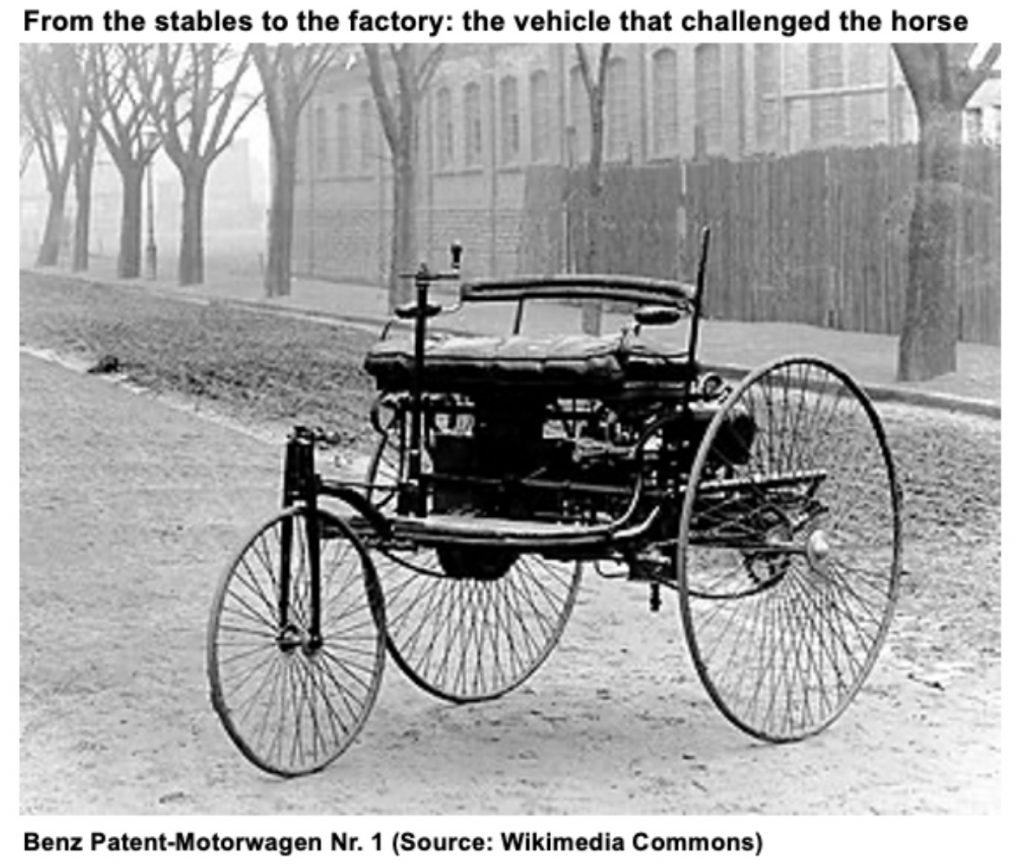
Already at its debut, the first Benz reached about 16 km/h, faster than the average speed of a horse (10–15 km/h).
Its range per full tank was around 45 km, but — as Bertha Benz, Karl’s wife, demonstrated in 1888 — with refuelling stops along the way it was possible to cover more than 100 km in a single day, compared to the roughly 35 km a horse could manage.
Meanwhile, the structural limits of horse transport were becoming increasingly unsustainable. By the end of the nineteenth century, London hosted about 200,000 horses which, producing and dumping a total of 2,000 tons of manure per day, triggered the so-called “Great Horse Manure Crisis”. Streets were flooded with dung and urine that attracted flies and spread diseases such as typhoid fever.
In addition to the prohibitive cost of early automobiles, the new technology faced cultural resistance (the power of tradition) and psychological resistance (fear of the unknown).
But — then as now — it was above all the economic interests of the status quo that slowed adoption. Chief among these were the lobbies tied to the horse economy: an entire supply chain of breeders, blacksmiths, harness and feed manufacturers, and municipal horse-drawn transport services such as urban trams, all of whom viewed the car as an existential threat.
This resistance from the economic establishment naturally took on political and regulatory form. In Britain, the Red Flag Act of 1865 — originally intended for steam vehicles — required every road locomotive to be preceded by a man on foot waving a red flag, and imposed absurdly low speed limits. Remaining in force until 1896, it effectively prevented the spread of the first automobiles. In Italy and other European countries, subsequent regulations were equally strict, curbing automobile circulation well into the years leading up to the First World War.
The turning point: Henry Ford
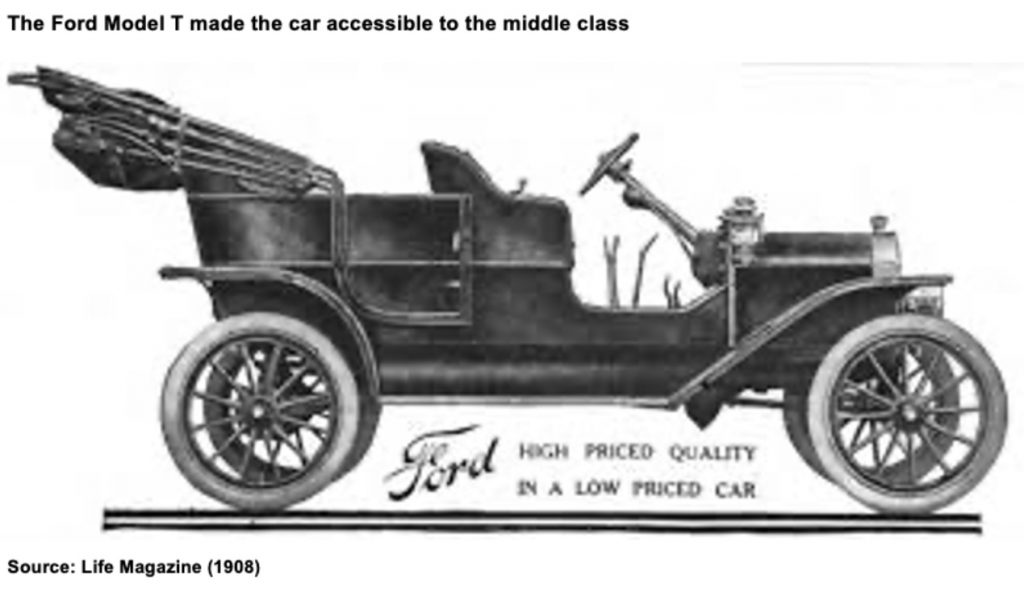
The assembly line introduced by Henry Ford in the early 1900s drastically reduced unit costs, making the automobile affordable for the middle class.
The widespread adoption of the Ford Model T was also supported by the abundance of oil made available in those same years through the exploitation of major new U.S. oil fields by John D. Rockefeller’s Standard Oil, which ensured large-scale, low-cost fuel supply.
With lower production and operating costs, the cost per kilometre of cars fell below that of horse-drawn transport — explaining the rapid switch-off of animal traction. The Model T marked the definitive victory over the horse and the carriages it pulled, which were gradually relegated to museums.
World War I
World War I accelerated everything.
The loss of millions of horses during the war was an indirect but significant factor in the replacement of animal traction with the automobile.
Wartime needs — for trucks, ambulances, and military vehicles — led to large-scale production, standardization, and improved reliability.
Thousands of soldiers and mechanics learned to drive and perform maintenance; upon returning home, they became the first civilian drivers and mechanics. In 1913, around 7,000 automobiles were in circulation in Italy; by 1927, the number had already exceeded 100,000.
The Advantages of Electric Cars Are Already Evident Today
As in the past, the advantages of the new technology are already clear and undeniable.
Compared to combustion vehicles, electric cars:
- are silent;
- are vibration-free;
- offer superior performance (instant acceleration, smoother drivability, no gear shifting);
- have lower maintenance costs;
- and have a far less negative impact on the climate, health, and the environment.
Despite the denialist positions prevalent in Trumpism in the United States and elsewhere, science has now extensively demonstrated the link between fossil-fuel emissions, greenhouse gas concentrations, and climate change.
The Intergovernmental Panel on Climate Change (IPCC) has concluded that human-induced CO₂ emissions — largely from transport and energy production — are the main cause of global warming observed since the mid-20th century. The International Energy Agency and the United Nations have stressed that reducing the stock of combustion-engine vehicles is a necessary condition to meet the Paris Agreement goals.
But even leaving aside this scientific certainty, another equally urgent one remains: the direct impact of smog and noise from combustion vehicles on human health. Traffic-related smog has been classified by the WHO as a proven carcinogen, with documented effects on lung cancer and cardiovascular diseases. The European Environment Agency estimates that air pollution causes over 300,000 premature deaths every year in Europe. Noise pollution from traffic is not a minor issue either: urban noise is the second leading environmental cause of disease after air pollution, linked to stress, sleep disorders, and heart disease.
And oil doesn’t pollute only when used: transporting it means accidents, spills, and chronic marine contamination. In 2023 alone, over 2,000 tons of crude oil spilled into the sea due to tanker accidents.
At the beginning of the 20th century, people used to claim that horses spread infectious diseases, while cars had no negative health effects — which wasn’t entirely true: cars simply had fewer negative effects. In the same way, electric vehicles have often been sold as entirely harmless for the environment and health. They do have an impact, but one that is vastly smaller than that of internal combustion vehicles. The use of renewable energy in lithium cell production and the improvement of battery recycling processes should further reduce this impact in the years to come.
Common Objections to Electric Cars
Critics focus on several limitations — some real but easily solvable, and others simply unfounded:
-
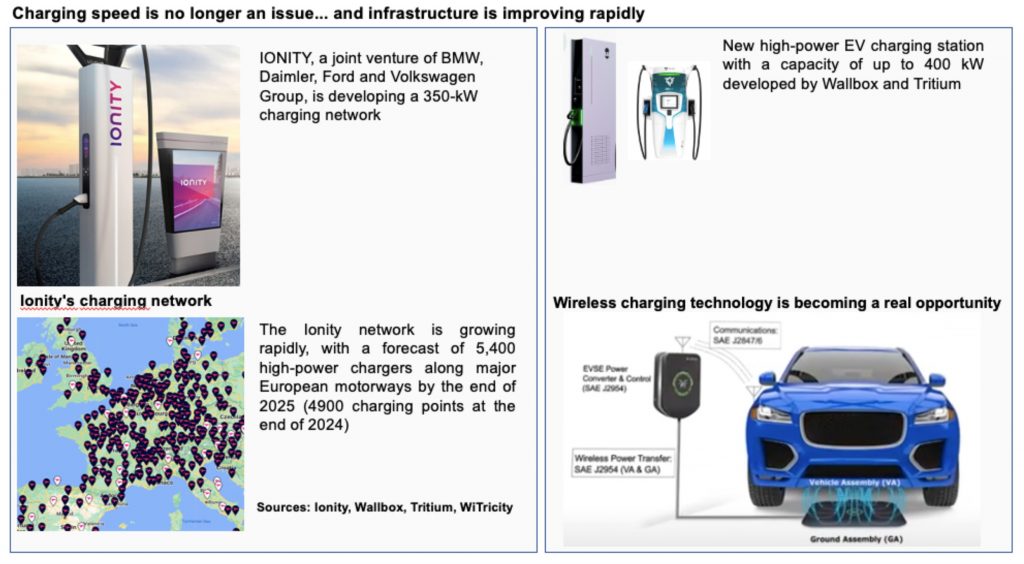
- Charging and Range. Charging stations across Europe are expanding rapidly, and unlike the internal combustion engine — which has already reached near-maximum refinement — battery chemistry is still evolving at a fast pace. It is now realistic to expect that in the near future vehicles will achieve ranges of around 1,000 km, with much faster charging times. BYD’s recent announcement of a battery capable of adding 470 km of range in just five minutes marked a true paradigm shift. Moreover, solutions such as wireless charging offer a scalable path even for the historic centers of European cities. It’s worth remembering that the potential for improvement in battery chemistry remains vast, whereas internal combustion engines have far less room left to improve in terms of efficiency and performance.
-
- Energy-intensive production. It is true that battery manufacturing today consumes a large amount of energy, but this limitation will shrink dramatically as renewable energy use expands. In the meantime, the simple fact of eliminating exhaust emissions in cities already translates into fewer cancers and respiratory diseases.
-
- Recycling. At present, only a small share of materials from lithium-ion batteries is recycled. However, the EU has set binding targets for the recovery of key materials — in some cases up to 85% — by 2036, effectively creating a new industrial sector.
-
- Costs. Battery prices continue to decline: in 2013 they exceeded $700/kWh; by 2023 they had already fallen to $139, and in 2024 reached $115/kWh. According to BloombergNEF, they are expected to drop below $100/kWh within a few years. Falling battery costs make electric cars increasingly competitive, especially in urban segments. The price gap with equivalent ICE models has narrowed rapidly, and in some cases — thanks to public incentives — EVs are already cheaper to purchase. The real bottleneck remains the cost of public charging, often inflated by utilities. Public intervention, such as government-imposed price caps, would make electric mobility immediately more competitive. It is therefore a political obstacle, not a technological one.
- Social impact. What will happen to workers in the internal combustion sector? The automotive supply chain employs around 13 million people in Europe, roughly 7% of total employment. The answer is not to halt the transition, nor to rely solely on sterile protectionism against Chinese EVs, but to retrain the workforce toward battery production, electrical components, and EV infrastructure. This approach builds manufacturing capacity and creates high-quality jobs in Europe — while protecting the local industry from Beijing’s otherwise unbeatable competition.
The Forces Slowing the Transition

As in the early days of the automobile, today’s resistance does not stem from technical flaws in the new technology, but from the influence of powerful economic lobbies — those of the horse industry back then, and today those of fossil fuels, internal combustion components, and electric utilities.
In the United States, Trumpism — fueled by funding from the oil and gas sector — has made the war against electric vehicles one of its main political battle horses. The oil and gas industry has led the opposition to Joe Biden’s pro-EV policies and generously financed Republican campaigns in the 2024 elections.
The intervention of the fossil fuel lobbies, however, only delays the inevitable: the internal combustion sector — like the horse economy before it — is destined for extinction. Defending the interests of a dying industry instead of protecting and building productive capacity in the sectors set to dominate 21st-century manufacturing is a major strategic mistake.
Batteries, electric motors, and power electronics are fundamental building blocks not only for electric vehicles, but also for a wide range of emerging sectors such as drones and robotics — technologies that are essential to advanced defense systems and therefore to national and regional security, as demonstrated by the ongoing conflict in Ukraine.
Increasingly, lithium batteries will also supply the energy that powers the data centers at the core of today’s AI revolution.
The industrial implications are enormous: the supply chain needed to manufacture a smartphone or a robot is no longer very different from the one required to produce an electric car or a military drone. It is no coincidence that Xiaomi — originally a smartphone manufacturer — has rapidly become one of China’s largest EV producers. And BYD, thanks to its vertical integration in electric technologies, is now among the most powerful manufacturing companies on the planet.
For Europe, this means that subsidizing battery production, reallocating workers and capital to the new electric stack, and developing local supply chains is not only an ecological and industrial choice: like steel or semiconductors in the past, batteries today are also a geopolitical and defense necessity. If the Chinese and Koreans are too far ahead, Europe must encourage joint ventures with knowledge-sharing agreements — just as China once required from European manufacturers operating there.
An Investment Opportunity
Today, as in the past, change — and the resistance to it — creates enormous opportunities.
Right now, excessive pessimism surrounds electric mobility among investors and in the financial press, fueled by the political propaganda of fossil lobbies. As a result, stocks linked to the lithium battery ecosystem trade at extremely depressed and attractive valuations, especially outside China. Despite the dominance of momentum investing today, it is precisely when “everyone is against it” that the best investment opportunities arise.
This is exactly what we are seeing in markets such as Korea and Japan, where low multiples reflect negative narratives rather than industrial fundamentals. It is worth remembering that only Korea and Japan — two democratic nations — currently possess technologies that can truly compete with those of China, an autocratic country that cannot be considered fully reliable.
A century ago, it was war, Fordism, and abundant oil that imposed the internal combustion car; today, it will be consumers, climate and health regulations, geopolitical and security imperatives, and global competition — primarily from China and the United States — that drive the adoption of electric vehicles.
The lesson from history is clear: industrial transitions are slow and contested, but once underway, they become irreversible. Horse-drawn carriages ended up in museums — and in a few years, the same fate will await combustion engines. Because two technologies cannot coexist for long when one is clearly superior to the other.And because, in the end, history never repeats itself exactly — but it often rhymes. EVs are dead, long live the EVs.

How to Invest in Electric Mobility
Niche AM investment team has been a pioneer in the field: in 2015, it launched the world’s first thematic fund dedicated to electric mobility, managing it successfully until early 2018. In 2019, the team launched its follow-up with Niche AM — the Safe Capital Electric Mobility Value fund — once again focused on the lithium battery universe and managed with a deep value approach aimed at limiting volatility and downside risk. Click on the image below for more details about our fund.
Follow us LinkedIn
This is a marketing communication intended exclusively for institutional investors.
Please refer to the fund prospectus and KIDs before making any investment decision.
Niche Asset Management Limited
Authorized and Regulated by the Financial Conduct Authority
17 Lennox Garden London SW1X 0DB – Registered in England – No. 10805355
Back


PKDuration Educational Resource
PKDuration Educational Resource